 English
  Українська
 Español
 Deutsch
 Français
 日本語
日本語 Русский
 한국어
한국어 Polski
 中文 (中国)
 Português
 Italiano
 Suomi
Suomi Svenska
 中文 (台灣)
 Dansk
Dansk Slovenčina
 Türkçe
 Nederlands
 Magyar
 ไทย
ไทย हिन्दी
 Ελληνικά
 Tiếng Việt
 Lietuviškai
 Latviešu valoda
 Eesti
Eesti Čeština
 Română
 Norsk Bokmål
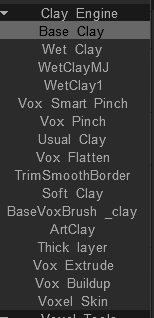
Base Clay: The basic brush for the voxel brushes. Duplicate, give the proper name, and customize it. This tool does not depend on the Alpha, so there is no difference in what alpha do you use. You may edit the Brush parameters -> Modifiers -> Some Item ->Use current alpha to use the alpha.
Wet Clay: This is similar to real clay. It consists of a clay effect and a little smudge.
Vox Smart Pinch: Vox Smart Pinch operates similarly to Smart Pinch in Surface Mode, where it detects angles in the surface to apply extrusion inwardly or outwardly + pinching automatically.
Vox Pinch: This option draws the surface area closer to the radial center of the cursor.
Usual Clay:
Vox Flatten: This mode flattens the surface beneath the cursor by raising or lowering points to a common plane.
Trim Smooth Border:
Soft Clay:
Thick layer: Clay effect without the constant increment (no buildup).
Vox Extrude: The extrude of the voxel’s surface.
Vox Buildup: Constant buildup of the surface while the brush moves.
Voxel Skin: This brush demonstrates the possibility to use alphas with mixed positive and negative extrusion. It depends on the checkbox “Surface-like mode” in Brush settings-> Modifiers.
Alphas imported from images (including .exr) may be mixed positive and negative, it allows making more realistic skin details. Negative alphas work for draw/extrude-like brushes in sculpt room.
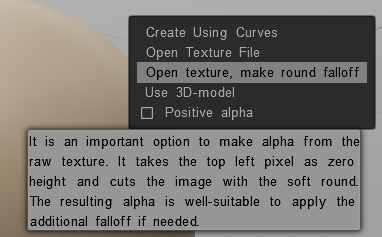
Use [+] in the alphas palette, “Open texture, make round falloff” to add different types of skin/noise: Alphas may be imported as rounds with accurate falloff, it simplifies making alphas from the raw textures a lot. This option available in alphas palette or using drag&drop.
What’s the difference of Vox Clay, Base Clay and Wet clay
The “Clay” family of brushes are designed to mimic real-world sculpting materials, with different behaviors regarding how they add volume and interact with the surface.
Voxel Clay
- Behavior: Adds volume that behaves as a “pure” voxel operation. It acts like thick, moldable clay.
- Usage: Best for building up large, solid volumes or merging shapes together.
- Characteristics: It easily adds material to the model, and when smoothed, it blends seamlessly into the surrounding volume. It works directly with the underlying voxel density.
Base Clay
- Behavior: Generally behaves as a standard, versatile, slightly “thinner” or smoother clay brush compared to regular VOX Clay.
- Usage: Ideal for initial, general sculpting and laying down base forms.
- Characteristics: It provides a balanced, smooth, and predictable addition of material.
Wet Clay
- Behavior: Creates a “muddier” or more liquid effect than Base Clay. It simulates clay that is very wet and soft.
- Usage: Perfect for creating soft, blending, or very smooth, organic transitions, or for adding materials that fill in crevices easily without having a hard edge.
- Characteristics: It provides a very smooth, often “slick” finish, similar to having a watered-down surface in real life.
Summary Table
| Brush | Consistency | Main Use Case | Behavior |
|---|---|---|---|
| Vox Clay | Thick/Firm | Building up large volume, merging | Solid, traditional clay |
| Base Clay | Moderate/Standard | General sculpting, base shapes | Smooth and versatile |
| Wet Clay | Muddy/Slick | Blending, soft transitions, filling | Soft, runny, smooth |
These brushes are part of the Voxel/Surface Hybrid engine, allowing you to use them interchangeably in the Voxel Room to manipulate volumes freely.
Tutorials
Clay Engine brushes: by Anton Tenitsky. Discord: / discord Instagram: / tenitskyart
Artstation: https://www.artstation.com/tenitsky