 Eesti
Eesti 
1. What is a Node Graph?
A NodeGraph is a single, separate node scheme that you can open and edit in the node editor. As a rule, a node system consists of objects, objects consist of components, and components consist of Behaviors and Node Graphs. Node graphs consist of nodes, and nodes consist of source codes, properties, defines, and the connections between them. Moreover, properties and defines can form connections with nodes of other schemes, and even any other objects
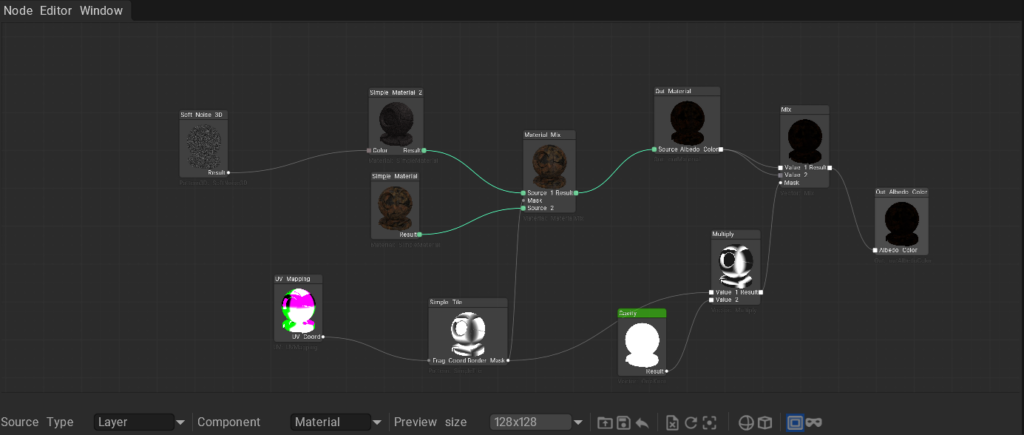
2. Advanced Work with Nodes and Properties
Working in the Node Editor (`Windows -> Panels -> Node Editor`) has a number of hidden functions that significantly speed up the artist’s work.
2.1. Micro-preview of any property (Ctrl + Hover)
This is one of the most important features for debugging complex materials.
When your graph grows, it can sometimes be difficult to understand exactly what a specific node is doing somewhere in the middle of the chain.
– Press and hold the `Ctrl` key and simply hover the mouse cursor over any pin (input/output) or property of a node in the node editor (by hovering the cursor over an incoming link, you will see the result with the influence of expressions and modifiers).
– 3DCoat will instantly render an isolated preview of exactly this stage of the graph directly on your model in the viewport (or as a pop-up hint).
– *Example:* You have mixed a *Curvature* map with *Fractal Noise*. By holding `Ctrl` over the output of this node, you will see the black and white dirt mask as it currently looks, before applying color or normals.
– To finely tune the output or input data of a connection, hover the mouse over it, hold `Ctrl`, and left-click. You will see the result of this specific connection until you press Esc.
2.2. Preview of the material on the entire model (Without mask)
When you are adjusting smart material parameters (e.g., brick tiling or skin texture), you often need to see the big picture on the entire object to correctly assess the scale.
– In the Node Editor interface (or on the tool panel), there is a global preview button (often indicated by an eye icon or the `Preview Material` mode).
– When pressed, the current node material temporarily covers the entire model completely, ignoring your current mask, layer conditions, or brush area.
– This allows you to perfectly adjust the scale and parameters of the material in the context of the entire object. As soon as you start painting or turn off this button, the material will return to its boundaries (mask).
3. Data Management: GlobalVars and LocalVars
For your node materials not to be just static images, 3DCoat uses a system of Variables. They can be configured in the Object Inspector.
3.1. LocalVars
– These are parameters that belong exclusively to the current material, layer, or node.
– For example: rust color, size of a specific scratch.
– If you copy a material, its local variables will be independent of the original.
– You can make each property visible or invisible in the Object Inspector. To do this, select the desired node and change its visibility state in the Node Inspector.
3.2. GlobalVars and ObjectVars
This is an incredibly powerful tool for large scenes and complex assets that allows a single variable in the Object Inspector to affect different node schemes simultaneously!
– The simplest way to link properties between different node systems is to click the button with the Link icon to the right of the incoming property, then open the node scheme and select the node with which you want to establish a link, and in the Node Inspector or Object Inspector, click the “Establish Link” button located to the right of the property.
– The second way to establish a link between different node schemes is to add the “GlobalVars” or “ObjectVars” behavior to the component in which it is located and enable their display in the node editor. GlobalVars will be visible in all node systems, while ObjectVars will only be visible in node systems located within a common object.
– How it works: You create a `GlobalVar` (for example, a Float type parameter named `DamageLevel`). Then you connect this variable inside 5 different smart materials (paint, metal, rubber, etc.).
– Result: By changing the `DamageLevel` value in only one place (in the global settings), all 5 materials instantly update the level of wear across the entire model. This is the ideal way to synchronize wear, wetness, or dirt across the entire object!
– Since the approach combines not just uniform values, but the output values of some node systems with others, global variables can be not only numbers but also any procedural maps.
—
5. Defines and Dynamic Node Properties
The internal architecture of 3DCoat (NGL language) uses special macros—Defines—which generate the node interface and can drastically change its logic on the fly. For the artist, these defines appear as control elements in the upper part of the *Object Inspector* panel for the selected node.
5.1. What are Defines?
Each node can have a set of basic settings that compile it differently:
– #enum (Dropdown lists): For example, selecting the layer blending mode (`Normal`, `Multiply`, `Screen`, etc.) or selecting the noise type.
– #bool (Checkboxes / Ticks): For example, enabling `Enable Shadows` or `Use Custom Mask`.
– #int (Integer sliders): Used for steps or iterations (e.g., `Iterations` from 1 to 10).
– #sampler (Texture loading): Direct loading of a raster image into the node without the need to create a separate `Texture` node.
5.2. Influence on the number of properties (pins)
The most powerful property of defines is that they are capable of dynamically changing the number of Inputs and Outputs of your node!
> [!TIP]
> **Practical Example:** Imagine you are using a procedural effect node. In the inspector, you see a checkbox (define) `#bool USE_CUSTOM_MASK`.
> As soon as you check this box, 3DCoat instantly recompiles the node on the fly, and a new physical input pin (e.g., `MaskInput`) appears on the node itself in the graph. If the checkbox is unchecked, the pin disappears.
**Why is this important for the artist?**
This allows you to keep node graphs extremely clean. Instead of having a giant universal node with 20 pins (of which you only use 3), you see a compact node with a minimum of inputs. By enabling a specific define in the settings (e.g., enabling support for transparency or normals), you instantly add the necessary pins to the node and connect the required links to them.
5.3. Links between Defines
Defines can also create links with other similar defines, analogous to variable properties:
– By creating a link between several defines, when one define changes, all those linked to it will take the same value.
– For example, if you have many nodes that apply a texture to the model and you want to choose the type of texture projection from one dropdown list, you can simply unify the corresponding define in all relevant nodes.
– Defines can also be unified between different node schemes that have the GlobalVars or LocalVars behavior type.
—
6. Layer Components — Pipeline Change
GPUPPP technology is most vividly demonstrated in the classic Layers panel. Now, layers are containers for node logic.
– Adding effects (Filters and Modifiers): Component icons have appeared in the Layers panel. By clicking them, you can assign a procedural modifier to the entire layer (e.g., node-based Displacement or Color Correction).
– Live Transformation: If previously you couldn’t undo an Adjust filter after applying it, now, by adding a node-based `NGFilter`, you can change the blur radius in the Object Inspector at any stage of work.
– Node Masks: Create layer masks using nodes. Instead of manual erasing, blend a noise node with Ambient Occlusion, and the mask will adapt to the model dynamically. By hovering the cursor over the mask in the layer and holding `Ctrl`, you will get an instant preview of the mask (black and white display on the model).
7. Quick Tips for Professionals
– Mathematics is your helper: The `Multiply` node is the fastest way to make mask edges look more ragged if you multiply it by `Fractal Noise`.
– Drag & Drop textures: Simply holding `Ctrl`, drag the texture from the Stencils, Strips, Masks window directly onto any field for texture selection, and you will automatically get the path to the corresponding file.
– Monitor speed (Profiler): All nodes run on the GPU, but excessive use of dozens of real-time noise generators can slow down the preview on weaker graphics cards. Use Baking to fix complex sections of the graph.
3. Node Anatomy and the Basics of Visual Programming
To create your own materials in the Node Room, you need to understand how nodes work. The node graph (your working canvas) is built from blocks. Information always flows from left to right.
| Structural element | Role and significance for the artist |
| Knots (Pins) | Connectors on the left (Input) and right (Output) sides of the node. The left receives data (e.g., mask or material), the right transmits the processed data further. Only one line can be connected to one input, but you can output as many lines as you want from one output. |
| (Links / Lines) | Flexible curved lines along which your paint, mask, or mathematical value “flows” from one node to another. |
| Default Inputs (Base Values) | Fields for manual number entry. If no input link is connected to the Roughness port, you can simply enter a number there (e.g., 0.4). If a link is established in the pin, the entered value will be multiplied by the input value by default, unless otherwise specified in the expression. |
| Color coding | Float: Black and white data (masks, roughness, relief height). Values from 0 to 1.Vector: A set of coordinates (X, Y, Z, W). Used for scaling or rotating a texture; a vector can have from 2 to 4 scalars.Color: Color in RGBA format (red, green, blue + transparency). Used for entering and transmitting colors, in which case a dialog for selecting a color will open for editing the value. |
(Note: A protection system is in place in the program—it will physically not allow you to connect incompatible ports, for example, material directly into vector coordinates. However, values of types Float, Vector, and Color will automatically convert and can form links between each other).
All simple types of input properties, such as Float, Vector, and Color, have integrated modifiers such as Simple, Levels, Curves, or Gradient, so there is no need to create separate nodes for simple modifications. Simple Modifier is the fastest but provides less control, Curves and Gradient are the slowest but provide the most control, including control of each color channel separately and many key points.