• Română
  • Documentația 3DCoat
  • Chapters
    • Introducere în 3DCoat
    • Noțiuni de bază
    • Interfață și navigare
    • Componentele Brush
    • Node System
    • Spații de lucru Camere
    • Scripting și Core API
    • Întrebări și răspunsuri
    • licensing
    • Tutoriale de instruire
  • Pilgway
  • Products
    • 3DCoat
    • 3DCoatTextura
    • 3DCoatPrint
    • PBRLibrary
  • Blog Posts
    • Creating 3D Character Using 3DCoat
  • Store
  • Română Română
    • English English
    • Українська Українська
    • Español Español
    • Deutsch Deutsch
    • Français Français
    • 日本語 日本語
    • Русский Русский
    • 한국어 한국어
    • Polski Polski
    • 中文 (中国) 中文 (中国)
    • Português Português
    • Italiano Italiano
    • Suomi Suomi
    • Svenska Svenska
    • 中文 (台灣) 中文 (台灣)
    • Dansk Dansk
    • Slovenčina Slovenčina
    • Türkçe Türkçe
    • Nederlands Nederlands
    • Magyar Magyar
    • ไทย ไทย
    • हिन्दी हिन्दी
    • Ελληνικά Ελληνικά
    • Tiếng Việt Tiếng Việt
    • Lietuviškai Lietuviškai
    • Latviešu valoda Latviešu valoda
    • Eesti Eesti
    • Čeština Čeština
    • Norsk Bokmål Norsk Bokmål
  • Documentația 3DCoat
  • Chapters
    • Introducere în 3DCoat
    • Noțiuni de bază
    • Interfață și navigare
    • Componentele Brush
    • Node System
    • Spații de lucru Camere
    • Scripting și Core API
    • Întrebări și răspunsuri
    • licensing
    • Tutoriale de instruire
  • Pilgway
  • Products
    • 3DCoat
    • 3DCoatTextura
    • 3DCoatPrint
    • PBRLibrary
  • Blog Posts
    • Creating 3D Character Using 3DCoat
  • Store
  • Română Română
    • English English
    • Українська Українська
    • Español Español
    • Deutsch Deutsch
    • Français Français
    • 日本語 日本語
    • Русский Русский
    • 한국어 한국어
    • Polski Polski
    • 中文 (中国) 中文 (中国)
    • Português Português
    • Italiano Italiano
    • Suomi Suomi
    • Svenska Svenska
    • 中文 (台灣) 中文 (台灣)
    • Dansk Dansk
    • Slovenčina Slovenčina
    • Türkçe Türkçe
    • Nederlands Nederlands
    • Magyar Magyar
    • ไทย ไทย
    • हिन्दी हिन्दी
    • Ελληνικά Ελληνικά
    • Tiếng Việt Tiếng Việt
    • Lietuviškai Lietuviškai
    • Latviešu valoda Latviešu valoda
    • Eesti Eesti
    • Čeština Čeština
    • Norsk Bokmål Norsk Bokmål
Expand All Collapse All
  • Introducere în 3DCoat
  • Noțiuni de bază
    • System requirements
    • Why 3DCoat is Unique?
    • Activarea 3DCoat
    • Eroare de pornire
      • Startup error Mac
    • Color management
    • Upgrading permanent license
    • Linux Setup
      • Linux initial setup per-user installation
      • Linux initial setup for system
      • Tablet setup
      • To GTK3 from GTK2
      • Error libicuuc.so.70
    • Structura folderelor
      • Custom documents folder
    • Diferite forme de „rezoluție”
    • Tablet on Window
    • Import & Export
    • Applinks în 3DCoat
      • Legătura aplicației Blender
        • Blender with the Applink in Linux
      • Blender 4.2/3/4/5 applink
      • Max Applink
      • Houdini applink
      • Lightwave uplink
  • Node System
    • PBM Channels
    • Node Editor
    • Node & Object Inspectors
    • Per-Pixel Painting
    • Node Graph
    • NodeGraph Language (NGL)
    • GPU Nodes
      • Color
      • GeometryIn
      • In
      • Layer
      • Material
      • Out
      • Pattern
      • Pattern3D
      • ShaderToy
      • Shape
      • Texture
      • Tilable
      • UV
    • Filters
    • Masks
    • Materials
    • Modifiers
    • Volumes
  • Navigation
    • Deschiderea casetei de dialog (meniu pornire rapidă)
    • Panoul de navigare
    • Cameră și navigație
      • Customize Navigation as Blender
    • Viewport Navigation Gizmo
    • Left tool panel
    •  Activity Bar
    • Navigare folosind dispozitive 3DConnexion
      • How to compile Spacenavd on non Ubuntu distro
    • Space Bar Menu
    • Stylus doesn’t work in sculpting
    • Taste rapide
  • Interfață și navigare
    • Meniul Fișier
    • Meniu Editare
      • Calculate Curvature
      • Calculate Occlusion
      • Light Baking Tool
      • Preferințe
    • Meniu Vizualizare
    • Simetrie
    • Textures
    • Calculate
    • Meniul Straturi
    • Înghețați meniul
    • Hide
    • Bake
    • Curbe 2022
      • Meniul Curbe
      • Curves Properties RMB
      • Umpleți cu strat de plasă
      • Scale of imported curves
    • Meniul Windows
      • Panouri pop-up Windows cu file
      • Glisoare
    • Scripts
    • Addons
    • Capture
    • Meniul de ajutor
    • Personalizare
    • Modificați sau creați o cameră nouă
  • Componentele Brush
    • Brush Top Bar
    • Perii de uz general
      • Creați pensule și decalcomanii
      • Realizarea alfa din sculptura curentă
      • Creați o Brush dintr-un obiect 3D
      • Create brushes based on Curves
      • Load photoshop .abr brushes
    • Accident vascular cerebral
      • Meniu pop-up Curves
    • Opțiuni de Brush
    • Limitator de condiții
    • Panoul de benzi
    • Panoul Șabloane
    • Materiale inteligente
      • Adăugați imagini sau materiale noi
      • Atașați un material Smart la un strat
      • Import Quixel Megascans
    • Cum se creează presetări pentru Brush
  • Spații de lucru Camere
    • Painting
      • Painting cu textură și moduri
        • Painting Per-Pixel
        • Painting cu deplasare (Micro-Vertex)
        • Painting Ptex
        • Painting de suprafață (polipictura)
      • Import în camera de Painting
        • Initial CC subdivision
        • UV Set smoothing
        • Sharp (hard) edge
        • Blocați Normals
        • Încărcați un nou aspect UV după modificările modelului
        • DAZ Genesis models into 3DCoat
        • ID map
      • Meniurile spațiului de lucru pentru Painting
        • Edit menu
        • Meniul Texturi
          • Instrumente de Baking a texturii
        • Ascunde
        • Meniu pentru Bake Paint
        • Selectorul de culori
      • Surface Materials
      • Bara de sus pentru Painting
      • Panoul Straturi
        • Panoul de amestecare
        • Layer and Clipping Masks
      • Instrumente pentru camera de Painting
      • Opacitate - Transparență
      • Modificați spațiul de lucru
        • Tweak Toolset
        • Se exportă din Camera Tweak
      • Panoul de previzualizare Mască/Material
      • Export din camera de Painting
    • Spațiu de lucru UV
      • UV Top Bar
      • Panoul de instrumente UV stânga
      • Panoul de previzualizare UV
      • Exemplu de flux de lucru UV
      • Importul în camera UV
      • Export din camera UV
    • Retopologie
      • Import în camera Retopo
      • Meniul Retopo Mesh și Meniul Coace
        • Modul oglindă virtuală
      • Bake menu
        • Treat Poly Groups as Paint Objects
        • Baking guide
      • Instrumentul Strokes în Retopologie
      • In capul barului
        • Selectați geometria
      • Panoul de instrumente din stânga în camera Retopologie
        • Scopul și funcția generală
        • Adăugați geometrie
        • Retopo Tweak Tools
        • Instrumente UV
        • Comenzi pentru camera de retopologie
      • AUTORETOPO
        • Autopo guide
      • Poli Grupuri
    • Sculptează
      • Sculpt Layer
      • Sculpt Arborele
      • Opțiuni de Sculpt Brush
      • Top Bar
      • Motor cu Brush
      • Submeniu Geometrie
      • Sculptați meniul „clic dreapta”.
      • Shaders
      • Modul Voxel
        • Pure Voxel Sculpting
        • Densitate și rezoluție
        • Motor de lut
        • Instrumente Voxel
        • Instrumente de suprafață pe Voxels
        • Instrumente de ajustare Voxel
        • Painting volumetrică
        • Instrumente pentru obiecte Voxel
      • Modul de suprafață
        • Instrumente de suprafață
        • Instrumente personalizate pentru suprafață
        • Surface Layer
        • Instrumente de reglare a suprafeței
        • Painting de suprafață
        • Instrumente pentru obiecte de suprafață
        • Rezoluție pe mai multe niveluri
          • Multires tools
          • Multires adjust
          • Multires commands
      • Sculptează curbele
        • Curbe spline
        • Splines model creation
      • Deplasare vectorială
      • Instrumente de transformare a suprafeței
        • Instrumente de transformare Voxel
        • Instancer
        • Move
        • Pose
        • Fit
        • Reproject
        • Surface Array
      • Voxel Primitives și instrumente de Import
      • Booleeni vii
      • Comenzi pentru camera Sculpt
      • Import în Sculpt Room
      • Se exportă din Camera Sculpt
    • Face
      • Comparison of different roughness values
      • Funcțiile panoului de randare
      • Placă turnantă
      • Fakebake the lighting -non PBR-
    • Factures
      • Fluxul de lucru
    • Cel mai simplu
    • Modelare
      • Mesh Menu
      • Panoul de instrumente din stânga în camera de modelare
        • Adăugați geometrie
          • Selectat
        • Ajustare fina
        • Smart Hybrid
        • UV
          • Comenzi
        • Întreaga plasă
      • Exemplu de suprafață de mansardă de Fluffy
      • Blockout de Poeboi
      • Import Zbrush Polygroups for UV mapping
    • Kitbash - Creare rapidă de modele 3D
      • Create kitbash
      • Left tool panel Kitbash
    • 3DPrint
    • Photogrammetry
      • How to install Reality Capture
      • Reality Capture doesn’t show up ?
    • Mesh în camera NURBS
    • Nodes
      • Sculpt shaders Nodes Library
      • Open PBR
  • Scripting și Core API
    • Core API
    • API-ul Python
    • Extensions and Addons
  • 3DCoatPrint gratuit

Node Graph

55 views 0

Written by Volodymyr Makovetskyi
May 14, 2026

1. What is a Node Graph?

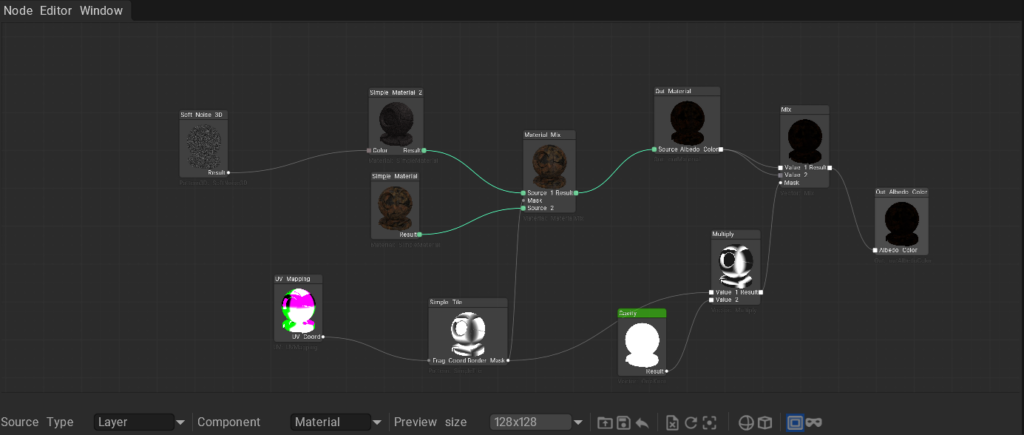
A NodeGraph is a single, separate node scheme that you can open and edit in the node editor. As a rule, a node system consists of objects, objects consist of components, and components consist of Behaviors and Node Graphs. Node graphs consist of nodes, and nodes consist of source codes, properties, defines, and the connections between them. Moreover, properties and defines can form connections with nodes of other schemes, and even any other objects 
2. Advanced Work with Nodes and Properties

Working in the Node Editor (`Windows -> Panels -> Node Editor`) has a number of hidden functions that significantly speed up the artist’s work.

2.1. Micro-preview of any property (Ctrl + Hover)

This is one of the most important features for debugging complex materials.

When your graph grows, it can sometimes be difficult to understand exactly what a specific node is doing somewhere in the middle of the chain.

– Press and hold the `Ctrl` key and simply hover the mouse cursor over any pin (input/output) or property of a node in the node editor (by hovering the cursor over an incoming link, you will see the result with the influence of expressions and modifiers).

– 3DCoat will instantly render an isolated preview of exactly this stage of the graph directly on your model in the viewport (or as a pop-up hint).

– *Example:* You have mixed a *Curvature* map with *Fractal Noise*. By holding `Ctrl` over the output of this node, you will see the black and white dirt mask as it currently looks, before applying color or normals.

– To finely tune the output or input data of a connection, hover the mouse over it, hold `Ctrl`, and left-click. You will see the result of this specific connection until you press Esc.

2.2. Preview of the material on the entire model (Without mask)

When you are adjusting smart material parameters (e.g., brick tiling or skin texture), you often need to see the big picture on the entire object to correctly assess the scale.

– In the Node Editor interface (or on the tool panel), there is a global preview button (often indicated by an eye icon or the `Preview Material` mode).

– When pressed, the current node material temporarily covers the entire model completely, ignoring your current mask, layer conditions, or brush area.

– This allows you to perfectly adjust the scale and parameters of the material in the context of the entire object. As soon as you start painting or turn off this button, the material will return to its boundaries (mask).

3. Data Management: GlobalVars and LocalVars

For your node materials not to be just static images, 3DCoat uses a system of Variables. They can be configured in the Object Inspector.

3.1. LocalVars

– These are parameters that belong exclusively to the current material, layer, or node.

– For example: rust color, size of a specific scratch.

– If you copy a material, its local variables will be independent of the original.

– You can make each property visible or invisible in the Object Inspector. To do this, select the desired node and change its visibility state in the Node Inspector.

3.2. GlobalVars and ObjectVars

This is an incredibly powerful tool for large scenes and complex assets that allows a single variable in the Object Inspector to affect different node schemes simultaneously!

– The simplest way to link properties between different node systems is to click the button with the Link icon to the right of the incoming property, then open the node scheme and select the node with which you want to establish a link, and in the Node Inspector or Object Inspector, click the “Establish Link” button located to the right of the property.

– The second way to establish a link between different node schemes is to add the “GlobalVars” or “ObjectVars” behavior to the component in which it is located and enable their display in the node editor. GlobalVars will be visible in all node systems, while ObjectVars will only be visible in node systems located within a common object.

– How it works: You create a `GlobalVar` (for example, a Float type parameter named `DamageLevel`). Then you connect this variable inside 5 different smart materials (paint, metal, rubber, etc.).

– Result: By changing the `DamageLevel` value in only one place (in the global settings), all 5 materials instantly update the level of wear across the entire model. This is the ideal way to synchronize wear, wetness, or dirt across the entire object!

– Since the approach combines not just uniform values, but the output values of some node systems with others, global variables can be not only numbers but also any procedural maps.

—

5. Defines and Dynamic Node Properties

The internal architecture of 3DCoat (NGL language) uses special macros—Defines—which generate the node interface and can drastically change its logic on the fly. For the artist, these defines appear as control elements in the upper part of the *Object Inspector* panel for the selected node.

5.1. What are Defines?

Each node can have a set of basic settings that compile it differently:

– #enum (Dropdown lists): For example, selecting the layer blending mode (`Normal`, `Multiply`, `Screen`, etc.) or selecting the noise type.

– #bool (Checkboxes / Ticks): For example, enabling `Enable Shadows` or `Use Custom Mask`.

– #int (Integer sliders): Used for steps or iterations (e.g., `Iterations` from 1 to 10).

– #sampler (Texture loading): Direct loading of a raster image into the node without the need to create a separate `Texture` node.

5.2. Influence on the number of properties (pins)

The most powerful property of defines is that they are capable of dynamically changing the number of Inputs and Outputs of your node!

> [!TIP]

> **Practical Example:** Imagine you are using a procedural effect node. In the inspector, you see a checkbox (define) `#bool USE_CUSTOM_MASK`.

> As soon as you check this box, 3DCoat instantly recompiles the node on the fly, and a new physical input pin (e.g., `MaskInput`) appears on the node itself in the graph. If the checkbox is unchecked, the pin disappears.

**Why is this important for the artist?**

This allows you to keep node graphs extremely clean. Instead of having a giant universal node with 20 pins (of which you only use 3), you see a compact node with a minimum of inputs. By enabling a specific define in the settings (e.g., enabling support for transparency or normals), you instantly add the necessary pins to the node and connect the required links to them.

5.3. Links between Defines

Defines can also create links with other similar defines, analogous to variable properties:

– By creating a link between several defines, when one define changes, all those linked to it will take the same value.

– For example, if you have many nodes that apply a texture to the model and you want to choose the type of texture projection from one dropdown list, you can simply unify the corresponding define in all relevant nodes.

– Defines can also be unified between different node schemes that have the GlobalVars or LocalVars behavior type.

—

6. Layer Components — Pipeline Change

GPUPPP technology is most vividly demonstrated in the classic Layers panel. Now, layers are containers for node logic.

– Adding effects (Filters and Modifiers): Component icons have appeared in the Layers panel. By clicking them, you can assign a procedural modifier to the entire layer (e.g., node-based Displacement or Color Correction).

– Live Transformation: If previously you couldn’t undo an Adjust filter after applying it, now, by adding a node-based `NGFilter`, you can change the blur radius in the Object Inspector at any stage of work.

– Node Masks: Create layer masks using nodes. Instead of manual erasing, blend a noise node with Ambient Occlusion, and the mask will adapt to the model dynamically. By hovering the cursor over the mask in the layer and holding `Ctrl`, you will get an instant preview of the mask (black and white display on the model).

7. Quick Tips for Professionals

– Use Frame / Group: To avoid getting lost in a large graph, select blocks of nodes and create a `Frame`. Give it a clear name (e.g., “Base Color” or “Rust Normals”) and a color.

– Mathematics is your helper: The `Multiply` node is the fastest way to make mask edges look more ragged if you multiply it by `Fractal Noise`.

– Drag & Drop textures: Simply holding `Ctrl`, drag the texture from the Stencils, Strips, Masks window directly onto any field for texture selection, and you will automatically get the path to the corresponding file.

– Monitor speed (Profiler): All nodes run on the GPU, but excessive use of dozens of real-time noise generators can slow down the preview on weaker graphics cards. Use Baking to fix complex sections of the graph.

3. Node Anatomy and the Basics of Visual Programming

To create your own materials in the Node Room, you need to understand how nodes work. The node graph (your working canvas) is built from blocks. Information always flows from left to right.

Structural elementRole and significance for the artist
Knots (Pins)Connectors on the left (Input) and right (Output) sides of the node. The left receives data (e.g., mask or material), the right transmits the processed data further. Only one line can be connected to one input, but you can output as many lines as you want from one output.
(Links / Lines)Flexible curved lines along which your paint, mask, or mathematical value “flows” from one node to another.
Default Inputs (Base Values)Fields for manual number entry. If no input link is connected to the Roughness port, you can simply enter a number there (e.g., 0.4). If a link is established in the pin, the entered value will be multiplied by the input value by default, unless otherwise specified in the expression.
Color codingFloat: Black and white data (masks, roughness, relief height). Values from 0 to 1.Vector: A set of coordinates (X, Y, Z, W). Used for scaling or rotating a texture; a vector can have from 2 to 4 scalars.Color: Color in RGBA format (red, green, blue + transparency). Used for entering and transmitting colors, in which case a dialog for selecting a color will open for editing the value.

(Note: A protection system is in place in the program—it will physically not allow you to connect incompatible ports, for example, material directly into vector coordinates. However, values of types Float, Vector, and Color will automatically convert and can form links between each other).

All simple types of input properties, such as Float, Vector, and Color, have integrated modifiers such as Simple, Levels, Curves, or Gradient, so there is no need to create separate nodes for simple modifications. Simple Modifier is the fastest but provides less control, Curves and Gradient are the slowest but provide the most control, including control of each color channel separately and many key points.

4. Node Library: Your Toolkit

All tools are grouped by their visual purpose. Here are the most important categories:

  • Color: Standard nodes for color processing
  • Geometry In: Nodes for obtaining information about the model’s geometry, such as the normal, position of each pixel, etc.
  • In: This is where all nodes that transmit data received by the node scheme at the input are located, such as material, its separate channels and properties, baked maps such as Occlusion, Cavity, GeometryInfo, or coordinates such as UV.
  • Layer: This is where nodes are located that provide information about what was painted with the brush on the given layer and which brush properties were set. This data allows you to create materials that are generated depending on the brush’s property and color.
  • Material: Nodes intended for convenient work with materials. Since materials contain dozens of channels, creating or processing each of them separately is difficult. These nodes help work with entire materials or their individual properties.
  • Out: Values that the node scheme transmits to the output; this can be a mask or a material, or object deformation.
  • Pattern (Patterns): Generators of procedural noise and patterns. Patterns 3D / 2D (Perlin, Simplex) generate basic natural dirt textures. Voronoi creates a structure similar to cells, scales, or cracked earth. Hexagon / SimpleWood are ready-made shapes for a quick start.
  • Variables: Allow you to move material settings to a convenient slider panel (Node Inspector). For example, by creating a Float Variable and naming it “Amount of Dirt,” you can change this parameter with a single slider movement without delving into the graph itself.
  • ShaderToy: Examples of how to transfer shaders from ShaderToy to 3DCoat nodes; this is done very simply because 3DCoat nodes are written in a language based on GLSL.
  • Texture: Nodes intended for reading texture images from files and applying them in the node system.
  • Vector (Mathematics): Various nodes for working with vectors, including float, Vector2, Vector3, Vector4, Color (this list includes types like float and Color; although they are not formally called vectors, they are compatible with them and can work without additional conversions).

5. Practical Masterclass: Creating the “Water Droplets” Material

Nothing explains node logic better than practice. Let’s create the effect of volumetric water droplets on a metal surface:

  1. Base (Metal): In the Node Room, create a Color Variable node, choose a dark gray color, and connect it to the Color port of the IO Albedo Color node. Create a Float Variable, name it “Gloss,” set it to 0.85, and connect it to the Gloss input of the IO Glass node.
  2. Generating Droplets: Add a Voronoi 2D node (Patterns category). It will create spherical areas, ideal for droplets. To control the size, connect a new Float Variable (“Droplet Size”) to the Scale port of this noise.
  3. Profiling (Lens): If you connect the noise directly to the relief, the droplets will be blurry. Insert a Curve node between them. In the curve settings, make the left part of the graph flat (dry metal), then make a sharp vertical rise (droplet edge) and a smooth rounding at the top.
  4. Displacement (Relief): Connect the output from Curve to the Displacement port in Material IO. Thanks to GPU acceleration, volumetric, physically correct water droplets that perfectly reflect light will instantly grow on your model.

Was this helpful?

Yes  No
Related Articles
  • Volumes
  • Modifiers
  • Materials
  • Masks
  • Filters
  • UV
Previously
Per-Pixel Painting
Up Next
NodeGraph Language (NGL)
AI:
Hi! How can I help you?
Attention: This is a beta version of AI chat. Some answers may be wrong. See full version of AI chat