• Français
  • Documentation 3DCoat
  • Chapters
    • Présentation de 3DCoat
    • Commencer
    • Interface et navigation
    • Composants de la Brush
    • Salles d’espaces de travail
    • Core API de Scripting et de base
    • Questions et réponses
    • licensing
    • Tutoriels de formation
  • Pilgway
  • Products
    • 3DCoat
    • 3DCoatTextura
    • 3DCoatPrint
    • PBRLibrary
  • Blog Posts
  • Store
  • Français Français
    • English English
    • Українська Українська
    • Español Español
    • Deutsch Deutsch
    • 日本語 日本語
    • Русский Русский
    • 한국어 한국어
    • Polski Polski
    • 中文 (中国) 中文 (中国)
    • Português Português
    • Italiano Italiano
    • Suomi Suomi
    • Svenska Svenska
    • 中文 (台灣) 中文 (台灣)
    • Dansk Dansk
    • Slovenčina Slovenčina
    • Türkçe Türkçe
    • Nederlands Nederlands
    • Magyar Magyar
    • ไทย ไทย
    • हिन्दी हिन्दी
    • Ελληνικά Ελληνικά
    • Tiếng Việt Tiếng Việt
    • Lietuviškai Lietuviškai
    • Latviešu valoda Latviešu valoda
    • Eesti Eesti
    • Čeština Čeština
    • Română Română
    • Norsk Bokmål Norsk Bokmål
  • Creating 3D Character Using 3DCoat
  • Documentation 3DCoat
  • Chapters
    • Présentation de 3DCoat
    • Commencer
    • Interface et navigation
    • Composants de la Brush
    • Salles d’espaces de travail
    • Core API de Scripting et de base
    • Questions et réponses
    • licensing
    • Tutoriels de formation
  • Pilgway
  • Products
    • 3DCoat
    • 3DCoatTextura
    • 3DCoatPrint
    • PBRLibrary
  • Blog Posts
  • Store
  • Français Français
    • English English
    • Українська Українська
    • Español Español
    • Deutsch Deutsch
    • 日本語 日本語
    • Русский Русский
    • 한국어 한국어
    • Polski Polski
    • 中文 (中国) 中文 (中国)
    • Português Português
    • Italiano Italiano
    • Suomi Suomi
    • Svenska Svenska
    • 中文 (台灣) 中文 (台灣)
    • Dansk Dansk
    • Slovenčina Slovenčina
    • Türkçe Türkçe
    • Nederlands Nederlands
    • Magyar Magyar
    • ไทย ไทย
    • हिन्दी हिन्दी
    • Ελληνικά Ελληνικά
    • Tiếng Việt Tiếng Việt
    • Lietuviškai Lietuviškai
    • Latviešu valoda Latviešu valoda
    • Eesti Eesti
    • Čeština Čeština
    • Română Română
    • Norsk Bokmål Norsk Bokmål
  • Creating 3D Character Using 3DCoat
Expand All Collapse All
  • Présentation de 3DCoat
  • Commencer
    • System requirements
    • Why 3DCoat is Unique?
    • Activation de 3DCoat
    • Erreur de démarrage
      • Startup error Mac
    • Color management
    • Upgrading permanent license
    • Linux Setup
      • Linux initial setup per-user installation
      • Linux initial setup for system
      • Tablet setup
      • To GTK3 from GTK2
    • Structure des dossiers
      • Custom documents folder
    • Différentes formes de « résolution »
    • Tablet on Window
    • Import et Export
    • Applinks dans 3DCoat
      • Lien de l'application Blender
        • Blender with the Applink in Linux
      • Blender 4.2/3/4/5 applink
      • Max Applink
      • Houdini applink
      • Lightwave uplink
  • Navigation
    • Boîte de dialogue d'ouverture (menu de démarrage rapide)
    • Panneau de navigation
    • Caméra et Navigation
      • Customize Navigation as Blender
    • Viewport Navigation Gizmo
    • Left tool panel
    •  Activity Bar
    • Navigation à l'aide d'appareils 3DConnexion
      • How to compile Spacenavd on non Ubuntu distro
    • Stylus doesn’t work in sculpting
    • Raccourcis
  • Interface et navigation
    • Menu Fichier
    • Modifier le menu
      • Calculate Curvature
      • Calculate Occlusion
      • Light Baking Tool
      • Préférences
    • Afficher le menu
    • Symétrie
    • Textures
    • Calculate
    • Menu Couches
    • Geler le menu
    • Hide
    • Bake
    • Courbes 2022
      • Menu Courbes
      • Curves Properties RMB
      • Remplir avec une couche de maille
      • Scale of imported curves
    • Menu Fenêtres
      • Panneaux contextuels Windows à onglets
      • Curseurs
    • Scripts
    • Addons
    • Capture
    • Menu d'aide
    • Personnalisation
    • Modifier ou créer une nouvelle pièce
  • Composants de la Brush
    • Barre supérieure de la Brush
    • Brosses usage général
      • Créer des pinceaux et des décalcomanies
      • Faire de l'alpha à partir de la sculpture actuelle
      • Créer un Brush à partir d'un objet 3D
      • Create brushes based on Curves
      • Load photoshop .abr brushes
    • Coups
      • Menu contextuel Courbes
    • Options de Brush
    • Limiteur de conditions
    • Panneau de bandes
    • Panneau Pochoirs
    • Matériaux intelligents
      • Ajouter de nouvelles images ou matériaux
      • Attacher un matériau intelligent à un calque
      • Import Quixel Material
    • Comment créer des préréglages pour le Brush
  • Salles d'espaces de travail
    • Painting
      • Painting de texture et modes
        • Painting par Per-Pixel
        • Painting par déplacement (Micro-Vertex)
        • Painting Ptex
        • Painting de surface (polypeinture)
      • Importation dans la salle de Painting
        • Initial CC subdivision
        • UV Set smoothing
        • Sharp (hard) edge
        • Verrouiller les normales
        • Charger une nouvelle présentation UV après les modifications du modèle
        • DAZ Genesis models into 3DCoat
      • Menus de l'espace de travail de Painting
        • Edit menu
        • Menu Textures
          • Outils de Baking de textures
        • Cacher
        • Menu pour la Bake Paint
        • Le sélecteur de couleurs
      • Barre supérieure pour la Painting
      • Le panneau Calques
        • Le panneau de fusion
        • Layer and Clipping Masks
      • Outils de salle de Painting
      • Opacité - Transparence
      • Ajuster l'espace de travail
        • Ensemble d'outils d'ajustement
        • Exportation à partir de la salle de réglages
      • Panneau de prévisualisation de masque/matériau
      • Exportation depuis la salle de Painting
    • Espace de travail UV
      • Barre supérieure UV
      • Panneau d'outils UV gauche
      • Panneau de prévisualisation UV
      • Exemple de flux de travail UV
      • Importation dans la chambre UV
      • Exportation depuis la chambre UV
    • Retopologie
      • Importation dans la salle Retopo
      • Menu Retopo Mesh et Menu Bake
        • Mode miroir virtuel
      • Bake menu
        • Treat Poly Groups as Paint Objects
        • Baking guide
      • Barre du haut
        • Sélectionnez la géométrie
      • Panneau d'outils de gauche dans la salle de retopologie
        • Objectif général et fonction
        • Ajouter une géométrie
          • Outil Traits en Retopologie
        • Outils d'ajustement Retopo
        • Outils UV
        • Commandes pour la salle de retopologie
      • AUTORETOPO
        • Autopo guide
      • Groupes poly
    • Sculpter
      • Sculpt Layer
      • Sculpter l'arbre
      • Options de Brush de sculpture
      • Top Bar
      • Moteur de Brush
      • Sous-menu Géométrie
      • Sculptez le menu "clic droit"
      • Shaders
      • Mode Voxel
        • Sculpture de Voxel purs
        • Densité et résolution
        • Moteur d'argile
        • Outils Voxel
        • Outils de surface sur Voxels
        • Outils de réglage des Voxel
        • Painting volumétrique
        • Outils d'objets Voxel
      • Mode surface
        • Outils de surface
        • Outils personnalisés de surface
        • Outils de réglage de surface
        • Painting de surface
        • Outils Objets surfaciques
        • Résolution à plusieurs niveaux
          • Multires tools
          • Multires adjust
          • Multires commands
      • Sculpter les courbes
        • Courbes splines
        • Splines model creation
      • Déplacement vectoriel
      • Outils de transformation de surface
        • Outils de transformation de Voxel
        • Instancer
        • Move
        • Pose
        • Fit
        • Reproject
        • Surface Array
      • Primitives Voxel et outils Import
      • Booléens en direct
      • Commandes pour la salle Sculpt
      • Import dans la salle de sculpture
      • Exportation depuis la salle Sculpt
    • Rendre
      • Comparison of different roughness values
      • Fonctions du panneau de rendu
      • Plaque tournante
      • Fakebake l'éclairage - non PBR-
    • Factures
      • Flux de travail
    • Le plus simple
    • La modélisation
      • Mesh Menu
      • Panneau d'outils de gauche dans la salle de modélisation
        • Ajouter une géométrie
          • Choisi
        • tordre
        • Smart Hybrid
        • UV
          • Commandes
        • Maillage entier
      • Exemple de surface de loft par Fluffy
      • Blocage par Poeboi
      • Import Zbrush Polygroups for UV mapping
    • Kitbash - Création rapide de modèles 3D
      • Create kitbash
      • Left tool panel Kitbash
    • 3DPrint
    • Photogrammetry
      • How to install Reality Capture
      • Reality Capture doesn’t show up ?
    • Maillage vers la salle NURBS
    • Nodes
      • Sculpt shaders Bibliothèque de nœuds
  • Core API de Scripting et de base
    • Scripting
    • Core API
    • API Python
  • 3DCoatPrint gratuit

Baking guide

520 views 0

Written by Carlos
January 11, 2025

Let we have mesh like on example. This is pictured schematically as side view, objects to be baked are
grey and blue, red is retopo mesh.
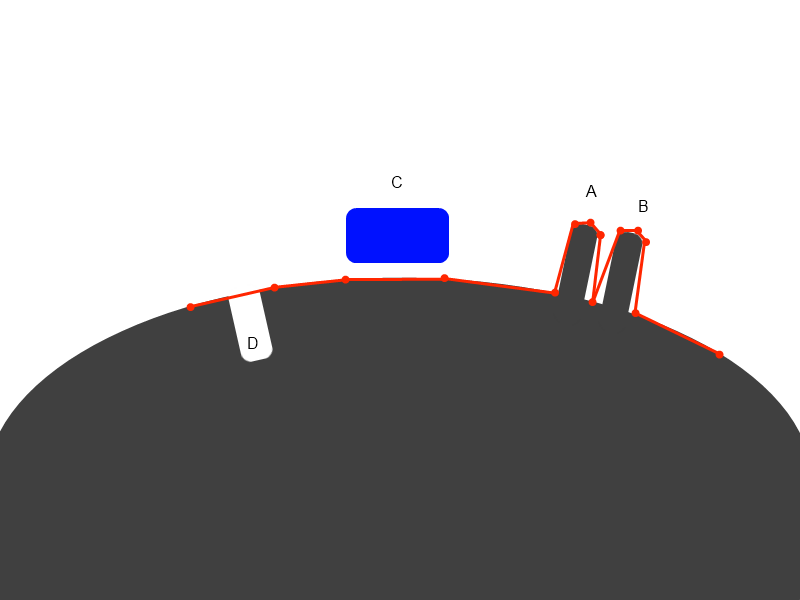
If you will try to bake in retopo room using Retopo->Bake with NM (to get normalmap) you will see the
dialog:
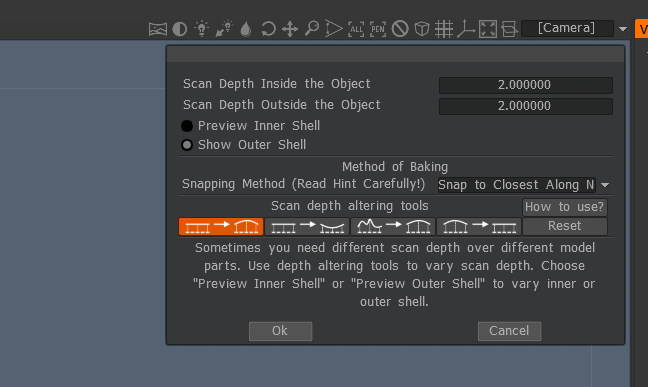
Let us look on settings. The principle of baking is scanning along retopo mesh normal to get to the baked
object surface. Later we will describe several approaches for this purpose.

Scan depth settings are well understood from this picture:
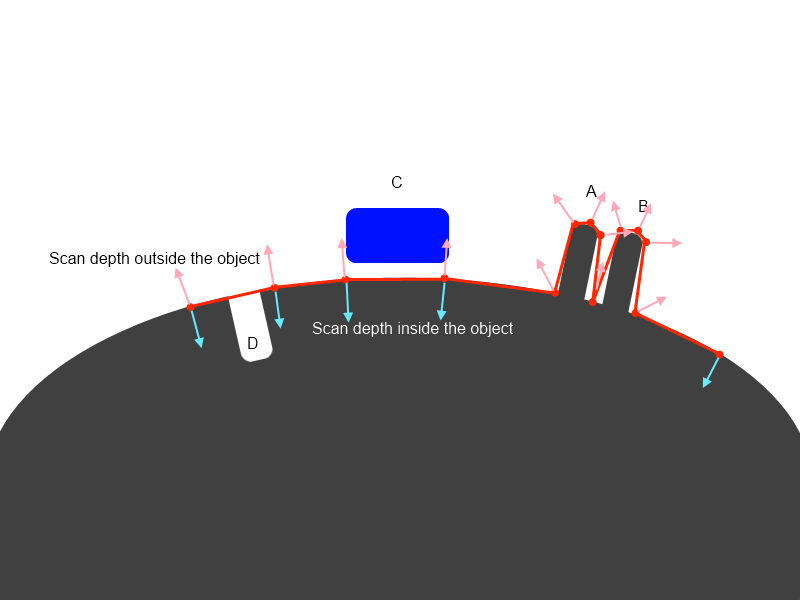
It are lengths or rays that follow normal direction. The longer rays, the more distant objects will be
taken into account. But if you will make it too long A and B will be baked incorrectly, if you will set it too
short, C and D will not be captured. We will describe later how to solve such problems in 3D-Coat. Let us
continue options discovering.

There are 2 methods of baking


1) Snap to closest along normal:
It is simplest approach that will work well in simple cases. It is default mode. In this case the point
closest to the retopo mesh will be baked. You may set bigger scan depth for this method and it still will
work. In our example you may set it twice longer and it will correctly capture details A, B, D. But C will
not be captured at all because grey surface is closest to the retopo mesh.

2) Snap to outer surface:
This method is intended for complex cases and rather pro users. It captures most distant details in
normal direction. Let us look on our example. If we will set outer scan distance twice longer then C will
be correctly baked, but A and B will not because of most outer will be neighbor spike and you will get
mess on normalmap. So you should not set big scan distance for this method. But if you will set it too
small so that A and B will be captured, C will not be captured.

For this purpose “Scan depth altering tools” introduced. Use the tools to alter scan depth, separately for
outer and inner shells of scanning depth. Grow, decrease, smooth or erase field. Use CTRL to invert
action and SHIFT to smooth field.

There are several additional tips for baking:


  • If you made not successful pass of baking and want to try it again, delete object that was add during
    baking process in paint room using Objects palette. Usually it is last object in Objects palette (Windows-Popups->Objects).
  • If you like result and want to export lowpoly mesh and textures – delete your reference objects (hide voxel objects or delete paint object) and export from paint room using File->Export or Textures->Export.
  • It is convenient to hide reference objects after baking to estimate result. Use VoxTree to hide voxels and Objects to hide paint and reference objects. Don’t forget to turn it on again if you want to bake them again!
  • It is much better to use Retopo->Bake with NM / Bake into scene (microverts) / Bake with Ptex instead of using Retopo->Texture baking tool because of much better flexibility.
  • If you are baking for microverts/ptex to get displacement and can’t get good result because of spikes in just several single points, use Layers->Clamp depth of the layer to cut off problematic spikes.
  • If you retopo each voxel layer separately you will get set of intersecting retopo layers. It usually happens if you are using Autopo. It is problematic to bake all that straightforward. If you have same names for retopo and voxel layers use Retopo->Use names correspondence for baking.
    You may also check if all is correct using Retopo->Check groups and volumes correspondence.
  • If you have huge reference mesh 5-100 M don’t try to import it as reference mesh, it will fail anyway. Use File->Import for vertex painting instead. It will work much better. You may use startup screen options.
  • It is better to avoid sharp angles between faces (like in example, retopo mesh between A and B), even angle a little less 90 degrees are not recommended, it will lead to problems if you are using 3DCoat’s method for calculating normals (Edit->Preferences->Normals calculation).
    Maya normals calculation method will work correctly in this case, so if you need sharp angles, use Maya normals calculation in Preferences.
    This is related to method of calculation. 3DCoat calculates normals as weighted average of neighbor faces, weight is proportional to face square. It allows to display bevel between faces correctly.
    But if there is sharp angle between big and small faces then vertex normal will be negative to small face normal and baking on that face will fail. Maya’s method calculates vertex normal as arithmetical average of neighbor faces normals. It is more appropriate for baking, but not good to display meshes without normalmap.
    Generally we recommend to add bevel between sharp edges.
Tags:baking guide

Was this helpful?

Yes  No
Related Articles
  • Surface Array
  • Top Bar
  • Curves Properties RMB
  • Left tool panel Kitbash
  • Create kitbash
  • Color management
Previously
Treat Poly Groups as Paint Objects
Up Next
Barre du haut
AI:
Hi! How can I help you?
Attention: This is a beta version of AI chat. Some answers may be wrong. See full version of AI chat