• 한국어
  • 3DCoat 설명서
  • Chapters
    • 3DCoat 소개
    • 시작하기
    • 인터페이스 및 탐색
    • Brush 구성 요소
    • 작업 공간 방
    • Scripting 및 Core API
    • 질문과 답변
    • licensing
    • 교육 자습서
  • Pilgway
  • Products
    • 3DCoat
    • 3DCoatTextura
    • 3DCoatPrint
    • PBRLibrary
  • Blog Posts
    • Creating 3D Character Using 3DCoat
  • Store
  • 한국어 한국어
    • English English
    • Українська Українська
    • Español Español
    • Deutsch Deutsch
    • Français Français
    • 日本語 日本語
    • Русский Русский
    • Polski Polski
    • 中文 (中国) 中文 (中国)
    • Português Português
    • Italiano Italiano
    • Suomi Suomi
    • Svenska Svenska
    • 中文 (台灣) 中文 (台灣)
    • Dansk Dansk
    • Slovenčina Slovenčina
    • Türkçe Türkçe
    • Nederlands Nederlands
    • Magyar Magyar
    • ไทย ไทย
    • हिन्दी हिन्दी
    • Ελληνικά Ελληνικά
    • Tiếng Việt Tiếng Việt
    • Lietuviškai Lietuviškai
    • Latviešu valoda Latviešu valoda
    • Eesti Eesti
    • Čeština Čeština
    • Română Română
    • Norsk Bokmål Norsk Bokmål
  • 3DCoat 설명서
  • Chapters
    • 3DCoat 소개
    • 시작하기
    • 인터페이스 및 탐색
    • Brush 구성 요소
    • 작업 공간 방
    • Scripting 및 Core API
    • 질문과 답변
    • licensing
    • 교육 자습서
  • Pilgway
  • Products
    • 3DCoat
    • 3DCoatTextura
    • 3DCoatPrint
    • PBRLibrary
  • Blog Posts
    • Creating 3D Character Using 3DCoat
  • Store
  • 한국어 한국어
    • English English
    • Українська Українська
    • Español Español
    • Deutsch Deutsch
    • Français Français
    • 日本語 日本語
    • Русский Русский
    • Polski Polski
    • 中文 (中国) 中文 (中国)
    • Português Português
    • Italiano Italiano
    • Suomi Suomi
    • Svenska Svenska
    • 中文 (台灣) 中文 (台灣)
    • Dansk Dansk
    • Slovenčina Slovenčina
    • Türkçe Türkçe
    • Nederlands Nederlands
    • Magyar Magyar
    • ไทย ไทย
    • हिन्दी हिन्दी
    • Ελληνικά Ελληνικά
    • Tiếng Việt Tiếng Việt
    • Lietuviškai Lietuviškai
    • Latviešu valoda Latviešu valoda
    • Eesti Eesti
    • Čeština Čeština
    • Română Română
    • Norsk Bokmål Norsk Bokmål
Expand All Collapse All
  • 3DCoat 소개
  • 시작하기
    • System requirements
    • Why 3DCoat is Unique?
    • 3DCoat 활성화
    • 시작 오류
      • Startup error Mac
    • Color management
    • Upgrading permanent license
    • Linux Setup
      • Linux initial setup per-user installation
      • Linux initial setup for system
      • Tablet setup
      • To GTK3 from GTK2
      • Error libicuuc.so.70
    • 폴더 구조
      • Custom documents folder
    • 다양한 형태의 "결의안"
    • Tablet on Window
    • Import 및 Export
    • 3DCoat 의 Applinks
      • Blender 앱link
        • Blender with the Applink in Linux
      • Blender 4.2/3/4/5 applink
      • Max Applink
      • Houdini applink
      • Lightwave uplink
  • Navigation
    • 열기 대화 상자(빠른 시작 메뉴)
    • 탐색 패널
    • 카메라 및 내비게이션
      • Customize Navigation as Blender
    • Viewport Navigation Gizmo
    • Left tool panel
    •  Activity Bar
    • 3DConnexion 장치를 사용한 탐색
      • How to compile Spacenavd on non Ubuntu distro
    • Space Bar Menu
    • Stylus doesn’t work in sculpting
    • 단축키
  • 인터페이스 및 탐색
    • 파일 메뉴
    • 편집 메뉴
      • Calculate Curvature
      • Calculate Occlusion
      • Light Baking Tool
      • 기본 설정
    • 메뉴 보기
    • 대칭
    • Textures
    • Calculate
    • 레이어 메뉴
    • 정지 메뉴
    • Hide
    • Bake
    • 곡선 2022
      • 곡선 메뉴
      • Curves Properties RMB
      • 메쉬 레이어로 채우기
      • Scale of imported curves
    • 윈도우 메뉴
      • 탭 Windows 팝업 패널
      • 슬라이더
    • Scripts
    • Addons
    • Capture
    • 도움말 메뉴
    • 커스터마이징
    • 새 방 수정 또는 만들기
  • Brush 구성 요소
    • Brush 상단 바
    • 브러쉬 일반 사용
      • 브러시 및 데칼 만들기
      • 현재 조각에서 알파 만들기
      • 3D 개체에서 Brush 만들기
      • Create brushes based on Curves
      • Load photoshop .abr brushes
    • 스트로크
      • 곡선 팝업 메뉴
    • Brush 옵션
    • 조건 제한기
    • 스트립 패널
    • 스텐실 패널
    • 스마트 소재
      • 새로운 이미지 또는 자료 추가
      • 스마트 재료를 레이어에 연결
      • Import Quixel Megascans
    • Brush 용 사전 설정을 만드는 방법
  • 작업 공간 방
    • Painting
      • 텍스처 Painting 및 모드
        • Per-Pixel Painting
        • 변위 Painting (Micro-Vertex)
        • Ptex Painting
        • 표면 Painting (폴리페인팅)
      • Painting 룸으로 가져오기
        • Initial CC subdivision
        • UV Set smoothing
        • Sharp (hard) edge
        • 법선 잠금
        • 모델 변경 후 새 UV 레이아웃 로드
        • DAZ Genesis models into 3DCoat
        • ID map
      • Painting 작업 영역의 메뉴
        • Edit menu
        • 텍스처 메뉴
          • 텍스처 Baking 도구
        • 숨다
        • Bake Paint 용 메뉴
        • 색상 선택기
      • Surface Materials
      • Painting 위한 상단 바
      • 레이어 패널
        • 블렌딩 패널
        • Layer and Clipping Masks
      • Painting 룸 도구
      • 불투명도 - 투명도
      • 작업 공간 조정
        • 조정 도구 세트
        • Tweak Room에서 내보내기
      • 마스크/재료 미리보기 패널
      • Painting 룸에서 내보내기
    • UV 작업 공간
      • UV 탑 바
      • UV 왼쪽 도구 패널
      • UV 미리보기 패널
      • UV 워크플로우 예시
      • UV 룸으로 가져오기
      • UV Room에서 내보내기
    • 리토폴로지
      • Retopo Room으로 가져오기
      • Retopo Mesh 메뉴 및 Bake 메뉴
        • 가상 미러 모드
      • Bake menu
        • Treat Poly Groups as Paint Objects
        • Baking guide
      • 리토폴로지의 스트로크 도구
      • 탑바
        • 지오메트리 선택
      • 리토폴로지 룸의 왼쪽 도구 패널
        • 전반적인 목적 및 기능
        • 형상 추가
        • Retopo 조정 도구
        • UV 도구
        • 리토폴로지 룸 명령
      • 오토레토포
        • Autopo guide
      • 폴리 그룹
    • 조각하다
      • Sculpt Layer
      • 조각 나무
      • 조각 Brush 옵션
      • Top Bar
      • Brush 엔진
      • 형상 하위 메뉴
      • 조각 "오른쪽 클릭" 메뉴
      • 셰이더
      • Voxel 모드
        • 순수한 Voxel 조각
        • 밀도 및 해상도
        • 클레이 엔진
        • Voxel 도구
        • 복셀의 표면 도구
        • Voxel 조정 도구
        • 볼륨 Painting
        • Voxel 개체 도구
      • 표면 모드
        • 표면 도구
        • 표면 맞춤 도구
        • Surface Layer
        • 표면 조정 도구
        • 표면 Painting
        • 표면 개체 도구
        • 다중 레벨 해상도
          • Multires tools
          • Multires adjust
          • Multires commands
      • 조각 곡선
        • 스플라인 곡선
        • Splines model creation
      • 벡터 변위
      • 표면 변환 도구
        • Voxel 변환 도구
        • Instancer
        • Move
        • Pose
        • Fit
        • Reproject
        • Surface Array
      • Voxel 프리미티브 및 Import 도구
      • 라이브 부울
      • 조각실 명령
      • 조각실로 Import
      • 조각실에서 내보내기
    • 세우다
      • Comparison of different roughness values
      • 렌더 패널 기능
      • 턴테이블
      • 조명을 페이크 베이크 -비 PBR-
    • Factures
      • 워크플로우
    • 가장 단순함
    • 모델링
      • Mesh Menu
      • 모델링 룸의 왼쪽 도구 패널
        • 형상 추가
          • 선택된
        • 비틀기
        • Smart Hybrid
        • UV
          • 명령
        • 전체 메시
      • Fluffy의 로프트 표면 예
      • Poeboi의 블록아웃
      • Import Zbrush Polygroups for UV mapping
    • Kitbash - 빠른 3D 모델 생성
      • Create kitbash
      • Left tool panel Kitbash
    • 3DPrint
    • Photogrammetry
      • How to install Reality Capture
      • Reality Capture doesn’t show up ?
    • 메시를 NURBS 룸으로
    • Nodes
      • 조각 셰이더 노드 라이브러리
      • Open PBR
  • Scripting 및 Core API
    • Scripting
    • Core API
    • 파이썬 API
    • Extensions and Addons
  • 무료 3DCoatPrint

Open PBR

35 views 0

Written by Carlos
May 1, 2026

OpenPBR is an open-source, standardized “uber-shader” specification developed by Adobe and Autodesk, designed to provide a unified physically-based rendering (PBR) material model across different DCC (Digital Content Creation) tools and renderers.

Overview


Designed as an über-shader, it aims to be capable of accurately modeling the vast majority of CG Materials used in practical visual effects and feature animation productions.
It is heavily based on MaterialX, acting as a high-fidelity shading model intended to merge the capabilities of Autodesk Standard Surface and Adobe Standard Material.
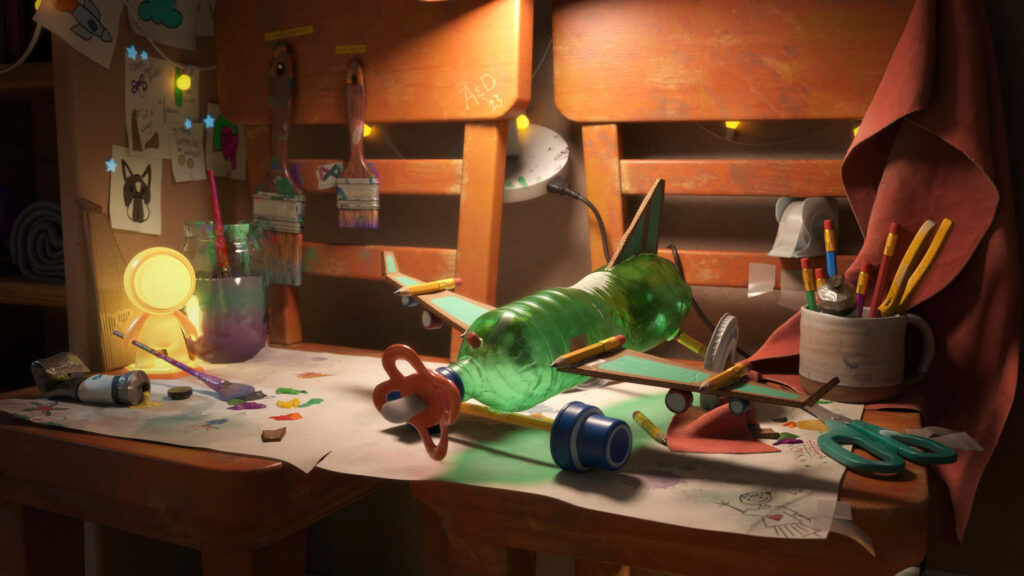
It is hosted by the Academy Software Foundation (ASWF) and organized as a subproject of MaterialX.
More information about the history and design can be found on this page detailing the OpenPBR Surface specification.

Key Components & Libraries

  • OpenPBR Surface (Core Specification): The fundamental model, defining parameters for surface layering such as base, coat, thin film, and fuzz.
  • MaterialX Implementation: OpenPBR is primarily defined and used via MaterialX node definitions (.mtlx), allowing for consistent appearance between Arnold, USD, and real-time engines.
  • NVIDIA SimReady Materials: The PhysicalAI-SimReady-Materials GitHub repository contains USD/MaterialX-based materials utilizing OpenPBR v1.1.
  • OpenPBR Shader Playground: A GitHub project by DigitalProductionExampleLibrary containing MaterialX files and USD examples demonstrating the shader’s capabilities.
  • Reference BSDF: A reference implementation for the OpenPBR BSDF (Bidirectional Scattering Distribution Function) exists on GitHub for developers

Key Features of OpenPBR Nodes

  • Layering System: Uses a “slab” model (base, coat, fuzz, emission).
  • Fuzz Layer: Replaces traditional sheen to represent microfiber reflections.
  • Advanced Thin Film: Offers micrometer-based thickness for better iridescent effects.
  • Metalness: Uses Specular Weight to control metal reflectivity.
  • Uniformity: It is designed to be cross-platform, making it ideal for USD-based workflows

The OpenPBR material is made up of several layers.

  • Base: The base layer sits at the bottom and can be configured to simulate many material types. It can represent a dielectric or metallic material and is responsible for the primary reflection layer. This is controlled by the Metalness parameter found in the Base parameters group. Normally materials are either fully metallic (Metalness 1) or fully dielectric (Metalness 0) but the OpenPBR material also supports a mixture when Metalness values fall between 0 and 1.
    • Metallic: When Metalness is used, reflections take on the Base Color and the Specular Color controls the color seen at glancing angles. Primary parameter groups are Base and Specular.
    • Dielectric: When a material is non-metallic it can be set up to represent the three main conditions covered below, but blending between them is possible by adjusting their relevant weights.
      • Glossy-diffuse: An opaque dielectric material that’s good for many common materials that don’t exhibit significant light scattering or transmission like wood and stone. Primary parameter groups are Base and Specular.
      • Subsurface: An opaque dielectric material that heavily scatters light internally like skin, plastic, marble, and wax. Primary parameter groups are Base, Specular, and Subsurface.
      • Translucent: A dielectric material that transmits and refracts a significant amount of light and one that is more transparent than a subsurface material. Primary parameter groups are Base, Specular, and Transmission.
  • Thin-Film: A very thin dielectric layer, measured in micrometers, between the base and coat layer used to represent the colorful effects as seen with soap bubbles, insects, and oil mixing with water.
  • Emission: A light emitting layer that sits above the base layer but below the coat and fuzz layers. The emissive layer is tinted by the coat and fuzz, making it easy to represent emissive surfaces like a TV screen — using the coat for the reflective glass and the fuzz for dust on top.
  • Coat: An optional dielectric layer that adds a secondary reflection layer over the base layer, great for clear coats and varnish.
  • Fuzz: An optional layer that sits on top of everything that can be used to simulate dust or the velvety sheen of cloth.

The main difference between the V-Ray material model and OpenPBR is the layers’ structure. See the diagram for information on how OpenPBR’s layers are calculated.
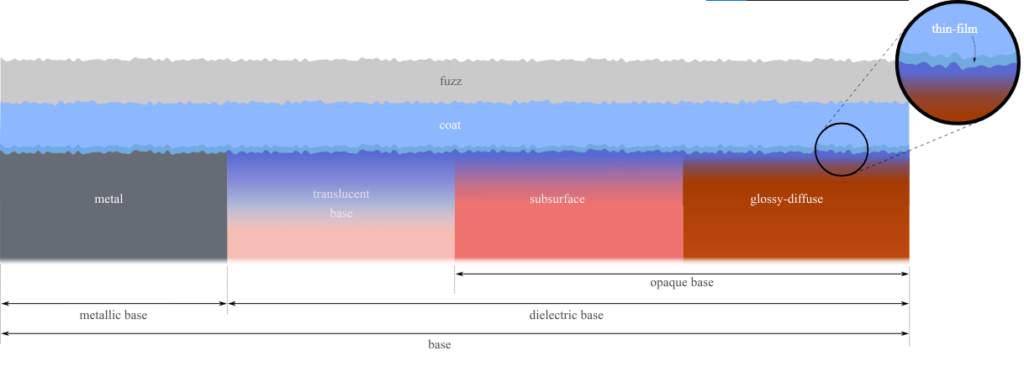
Schematic illustration of the idealized physical material that our shader models. Horizontal stacking of slabs represents statistical mixture and vertical stacking represents layering.

Unlike previous models such as Autodesk Standard Surface, ASWF define the model by describing the physical structure as unambiguously as possible, rather than by specifying a particular form of implementation.
At the level of computer graphics, the model is completely physically specified if the BSDF (Bidirectional Scattering Distribution Function) of each slab interface, and the volumetric properties of each slab ,edium, are specified.
The ground truth appearance of the model is then defined to be given by the BSDF obtained by physical light transport through the whole structure of component slabs.

Tutorials


Unlock Seamless Material Interchange for Virtual Worlds with OpenUSD, MaterialX, and OpenPBR: NVIDIA, and the Alliance for OpenUSD (AOUSD) announced the AOUSD Materials Working Group, an initiative for standardizing the interchange of materials in Universal Scene Description, known as OpenUSD.

Was this helpful?

Yes  No
Related Articles
  • Extensions and Addons
  • Surface Layer
  • Error libicuuc.so.70
  • Space Bar Menu
  • Surface Materials
  • Factures
Previously
조각 셰이더 노드 라이브러리
Up Next
Scripting 및 Core API
AI:
Hi! How can I help you?
Attention: This is a beta version of AI chat. Some answers may be wrong. See full version of AI chat