• Deutsch
  • 3DCoat Dokumentation
  • Chapters
    • Einführung in 3DCoat
    • Einstieg
    • Schnittstelle & Navigation
    • Brush
    • Node System
    • GPU Texturing
    • Arbeitsbereiche Räume
    • Scripting und Core API
    • Fragen & Antworten
    • Licensing
  • Learn
    • Getting Started
    • Painting
    • Sculpt
    • Modeling
    • Retopology
    • UV
    • Smart Materials
    • Nodes
    • Photogrammetry
    • Render
    • Print
    • Learning
    • Schulungs-Tutorials
  • Blog
    • Creating 3D Character Using 3DCoat
    • DAZ Genesis models into 3DCoat
    • Cavity and Curvature maps
    • Types of normal maps
    • Texture painting pipeline
    • Load new UV layout After Model Changes
    • Import Zbrush Polygroups for UV mapping
  • Products
    • 3DCoat
    • 3DCoatTextura
    • 3DCoatPrint
    • PBRLibrary
  • Store
  • Pilgway
  • Deutsch Deutsch
    • English English
    • Українська Українська
    • Español Español
    • Français Français
    • 日本語 日本語
    • Русский Русский
    • 한국어 한국어
    • Polski Polski
    • 中文 (中国) 中文 (中国)
    • Português Português
    • Italiano Italiano
    • Suomi Suomi
    • Svenska Svenska
    • 中文 (台灣) 中文 (台灣)
    • Dansk Dansk
    • Slovenčina Slovenčina
    • Türkçe Türkçe
    • Nederlands Nederlands
    • Magyar Magyar
    • ไทย ไทย
    • हिन्दी हिन्दी
    • Ελληνικά Ελληνικά
    • Tiếng Việt Tiếng Việt
    • Lietuviškai Lietuviškai
    • Latviešu valoda Latviešu valoda
    • Eesti Eesti
    • Čeština Čeština
    • Română Română
    • Norsk Bokmål Norsk Bokmål
  • 3DCoat Dokumentation
  • Chapters
    • Einführung in 3DCoat
    • Einstieg
    • Schnittstelle & Navigation
    • Brush
    • Node System
    • GPU Texturing
    • Arbeitsbereiche Räume
    • Scripting und Core API
    • Fragen & Antworten
    • Licensing
  • Learn
    • Getting Started
    • Painting
    • Sculpt
    • Modeling
    • Retopology
    • UV
    • Smart Materials
    • Nodes
    • Photogrammetry
    • Render
    • Print
    • Learning
    • Schulungs-Tutorials
  • Blog
    • Creating 3D Character Using 3DCoat
    • DAZ Genesis models into 3DCoat
    • Cavity and Curvature maps
    • Types of normal maps
    • Texture painting pipeline
    • Load new UV layout After Model Changes
    • Import Zbrush Polygroups for UV mapping
  • Products
    • 3DCoat
    • 3DCoatTextura
    • 3DCoatPrint
    • PBRLibrary
  • Store
  • Pilgway
  • Deutsch Deutsch
    • English English
    • Українська Українська
    • Español Español
    • Français Français
    • 日本語 日本語
    • Русский Русский
    • 한국어 한국어
    • Polski Polski
    • 中文 (中国) 中文 (中国)
    • Português Português
    • Italiano Italiano
    • Suomi Suomi
    • Svenska Svenska
    • 中文 (台灣) 中文 (台灣)
    • Dansk Dansk
    • Slovenčina Slovenčina
    • Türkçe Türkçe
    • Nederlands Nederlands
    • Magyar Magyar
    • ไทย ไทย
    • हिन्दी हिन्दी
    • Ελληνικά Ελληνικά
    • Tiếng Việt Tiếng Việt
    • Lietuviškai Lietuviškai
    • Latviešu valoda Latviešu valoda
    • Eesti Eesti
    • Čeština Čeština
    • Română Română
    • Norsk Bokmål Norsk Bokmål
Expand All Collapse All
  • Einführung in 3DCoat
  • Einstieg
    • System requirements
    • Why 3DCoat is Unique?
    • 3DCoat aktivieren
    • Fehler beim starten
      • Startup error Mac
    • Color management
    • Upgrading permanent license
    • Linux Setup
      • Linux initial setup per-user installation
      • Linux initial setup for system
      • Tablet setup
      • To GTK3 from GTK2
      • Error libicuuc.so.70
    • Ordnerstruktur
      • Custom documents folder
    • Verschiedene Formen der „Auflösung“
    • Tablet on Window
    • Import und Export
    • Applinks in 3DCoat
      • Blender -Applink
        • Blender with the Applink in Linux
      • Blender 4.2/3/4/5 applink
      • Max Applink
      • Houdini applink
      • Lightwave uplink
  • Navigation
    • Dialog öffnen (Schnellstartmenü)
    • Navigationsbereich
    • Kamera und Navigation
      • Customize Navigation as Blender
    • Viewport Navigation Gizmo
    • Left tool panel
    •  Activity Bar
    • Navigation mit 3DConnexion-Geräten
      • How to compile Spacenavd on non Ubuntu distro
    • Space Bar Menu
    • Stylus doesn’t work in sculpting
    • Hotkeys
  • Schnittstelle & Navigation
    • Dateimenü
    • Menü bearbeiten
      • Calculate Curvature
      • Calculate Occlusion
      • Light Baking Tool
      • Einstellungen
    • Ansicht-Menü
    • Symmetrie
    • Textures
    • Calculate
    • Ebenenmenü
    • Menü einfrieren
    • Hide
    • Bake
    • Kurven 2022
      • Kurvenmenü
      • Curves Properties RMB
      • Mit Maschenschicht füllen
      • Scale of imported curves
    • Windows-Menü
      • Windows-Popup-Bedienfelder mit Registerkarten
      • Schieberegler
    • Scripts
    • Addons
    • Capture
    • Hilfemenü
    • Anpassung
    • Raum ändern oder neu erstellen
  • Brush
    • Brush Top-Leiste
    • Bürsten allgemeine Verwendung
      • Erstellen Sie Pinsel und Abziehbilder
      • Aus der aktuellen Skulptur Alpha machen
      • Erstellen Sie einen Brush aus einem 3D-Objekt
      • Create brushes based on Curves
      • Load photoshop .abr brushes
    • Striche
      • Kurven-Popup-Menü
    • Brush
    • Bedingungen-Limiter
    • Streifen-Panel
    • Schablonen-Panel
    • Intelligente Materialien
      • Fügen Sie neue Bilder oder Materialien hinzu
      • Hängen Sie ein Smart-Material an eine Ebene an
      • Import Quixel Megascans
    • So erstellen Sie Voreinstellungen für Brush
  • Node System
    • Node Editor
    • Node & Object Inspectors
    • Node Graph
    • NodeGraph Language (NGL)
    • GPU Nodes
      • Color
      • GeometryIn
      • In
      • Layer
      • Material
      • Out
      • Pattern
      • Pattern3D
      • ShaderToy
      • Shape
      • Texture
      • Tilable
      • UV
      • Vector
    • Filters
    • Masks
    • Materials
    • Modifiers
    • Volumes
  • Kostenloser 3DCoatPrint
  • GPU Texturing
    • PBM Channels
    • Per-Pixel Painting
  • Arbeitsbereiche Räume
    • Painting
      • Painting & Modi
        • Per-Pixel Painting
        • Displacement Painting (Mikro-Vertex)
        • Ptex Painting
        • Painting (Polypainting)
      • Importieren in den Painting
        • Initial CC subdivision
        • UV Set smoothing
        • Sharp (hard) edge
        • Normalen sperren
        • Laden Sie nach Modelländerungen ein neues UV Layout
        • DAZ Genesis models into 3DCoat
        • ID map
      • Menüs des Painting Arbeitsbereichs
        • Edit menu
        • Texturen-Menü
          • Baking für Texturen
        • Verstecken
        • Menü für die Bake Paint
        • Der Farbwähler
      • Surface Materials
      • Obere Leiste für das Painting
      • Das Ebenenbedienfeld
        • Das Blending-Panel
        • Layer and Clipping Masks
      • Painting Werkzeuge
      • Deckkraft – Transparenz
      • Arbeitsbereich optimieren
        • Tweak-Toolset
        • Exportieren aus dem Tweak Room
      • Masken-/Materialvorschaufenster
      • Exportieren aus dem Painting
    • UV Arbeitsbereich
      • UV Leiste oben
      • UV Linkes Werkzeugfeld
      • UV Vorschaufenster
      • Beispiel für einen UV Workflow
      • Importieren in den UV Raum
      • Exportieren aus dem UV Raum
    • Retopologie
      • Importieren in den Retopo Raum
      • Retopo Mesh-Menü und Bake-Menü
        • Virtueller Spiegelmodus
      • Bake menu
        • Treat Poly Groups as Paint Objects
        • Baking guide
      • Striche-Werkzeug in Retopology
      • Obere Leiste
        • Geometrie auswählen
      • Linke Werkzeugtafel im Retopologieraum
        • Gesamtzweck und Funktion
        • Geometrie hinzufügen
        • Retopo Tweak-Tools
        • UV Werkzeuge
        • Befehle für den Retopologieraum
      • AUTORETOPO
        • Autopo guide
      • Poly-Gruppen
    • Bildhauen
      • Sculpt Layer
      • Baum formen
      • Brush Optionen
      • Top Bar
      • Brush
      • Geometrie-Untermenü
      • Gestalten Sie das „Rechtsklick“-Menü
      • Shader
      • Voxel Modus
        • Reines Voxel Sculpting
        • Dichte und Auflösung
        • Ton-Motor
        • Voxel -Tools
        • Oberflächenwerkzeuge auf Voxeln
        • Voxel Anpassungswerkzeuge
        • Volumetrische Painting
        • Voxel Objekte-Tools
      • Oberflächenmodus
        • Oberflächenwerkzeuge
        • Benutzerdefinierte Oberflächenwerkzeuge
        • Surface Layer
        • Werkzeuge zur Oberflächenanpassung
        • Painting
        • Mehrstufige Auflösung
          • Multires tools
          • Multires adjust
          • Multires commands
      • Kurven formen
        • Spline-Kurven
        • Splines model creation
      • Vektorverschiebung
      • Werkzeuge zur Oberflächentransformation
        • Voxel Transformationswerkzeuge
        • Instancer
        • Move
        • Pose
        • Fit
        • Reproject
        • Surface Array
      • Voxel Primitive und Import Tools
        • Live-Boolesche Werte
        • Befehle für den Sculpt-Raum
        • In Sculpt Room Import
        • Exportieren aus dem Sculpt Room
      • Machen
        • Comparison of different roughness values
        • Funktionen des Renderbereichs
        • Drehscheibe
        • Fakebake die Beleuchtung – kein PBR–
      • Factures
        • Arbeitsablauf
      • Am einfachsten
      • Modellieren
        • Mesh Menu
        • Linke Werkzeugtafel im Modellierungsraum
          • Geometrie hinzufügen
            • Ausgewählt
          • Optimieren
          • Smart Hybrid
          • UV
            • Befehle
          • Gesamtes Netz
        • Loft-Oberflächenbeispiel von Fluffy
        • Blockout von Poeboi
        • Import Zbrush Polygroups for UV mapping
      • Kitbash - Schnelle Erstellung von 3D-Modellen
        • Create kitbash
        • Left tool panel Kitbash
      • 3DPrint
      • Photogrammetry
        • How to install Reality Capture
        • Reality Capture doesn’t show up ?
      • Mesh zum NURBS-Raum
      • Nodes
        • Sculpt-Shader Nodes Library
        • Open PBR
    • Scripting und Core API
      • Core API
      • Python-API
      • Extensions and Addons

    Nodes

    1091 views 0

    Written by Carlos
    March 21, 2025

    The 3DCoat Node System is a non-destructive, procedural engine that lets artists build complex materials, masks, and shaders by visually linking mathematical operations, procedural noises, and geometry in a graph. Instead of drawing pixels destructively, the software dynamically compiles these node graphs into highly optimized GPU shader.
    Nodes let you to generate textures from procedural patterns within node-based graphics.

    Is Non-destructive texturing (Node-Based Workflow) No more limitations of classic pixel painting!
    Now you can create materials, masks, and effects using a visual editor (Node Editor).
    Any element — rust intensity, base color, glossiness, or scratches — remains editable at any stage of work. Change parameters and instantly observe the result on the 3D model in real time.

    How It Works Under the Hood


    Each node functions as an input, output, or operation. You connect nodes together in the Node Editor, and 3DCoat uses NodeGraph Language (NGL)—an extension of GLSL—to execute the math directly on your graphics card. This means the materials you create are resolution-independent and will automatically adapt to your 3D model’s curvature, ambient occlusion, and physical spac

    – High-performance GPU nodes (NGL) Under the hood of the new system, dynamic compilation of nodes into optimized shaders based on NodeGraph Language (NGL) is working. All procedural magic, mathematical operations, and noise generators are calculated directly on the graphics card (GPU).

    – A new generation of smart materials, masks, and other presets:

    • NGMaterials: Procedural smart materials that perfectly adapt to the curvature, shading (Ambient Occlusion), and other properties of your model.
    • NGMasks: Procedural “smart” masks for generating realistic wear, dirt, scratches, etc.
    • NGModifiers and NGFilters: Powerful tools for geometry deformation and procedural post-processing of current layers.

    – These materials support approximately 30 channels; you can read more about them in the documentation, in the PBM Channels section.

    – You can find more detailed documentation on these features in the Node System and GPU Texturing  sections; the documentation will be updated.

    Core Node Categories


    3DCoat provides a robust library of GPU nodes to control how your textures and materials behave

    In & Out: Primary data sources (inputs) and nodes that define the final routing into PBR channels like Albedo, Metalness, or Gloss (outputs).
    Material: High-level nodes used to assemble, mix, or break apart full PBR materials.
    Patterns & Pattern3D: Generators for 2D noises/geometric shapes and true volumetric 3D noise that flow seamlessly across UV seams.
    GeometryIn: Nodes that extract fundamental spatial data from the mesh, such as world position and surface normals.
    Color & Vector: Nodes dedicated to color correction and basic mathematical operations (e.g., Add, Subtract, Multiply) that act as the logic glue between nodes.
    Texture: Utilities for sampling external bitmaps, handling standard UV mapping, and triplanar projection.

    Practical Uses


    You can access the node graph editor directly from your Sculpt Layers or the Material IO tab. With it, artists can easily:

    • Generate resolution-independent Smart Materials.
    • Drive procedural surface effects (e.g., rust, wear, or dirt) based on model geometry.
    • Add detailed surface relief or displacement without altering base geometry.

    Updated User Interface New windows have been added for convenient work


    Node Editor (the main space for building logic), Node Inspector, and Object Inspector.
    You can pin any node parameters (using the “eye” icon) in the general object or layer parameters and easily change them via the Object Inspector.
    This allows for configuring complex materials with convenient sliders without constantly diving into the node graph.
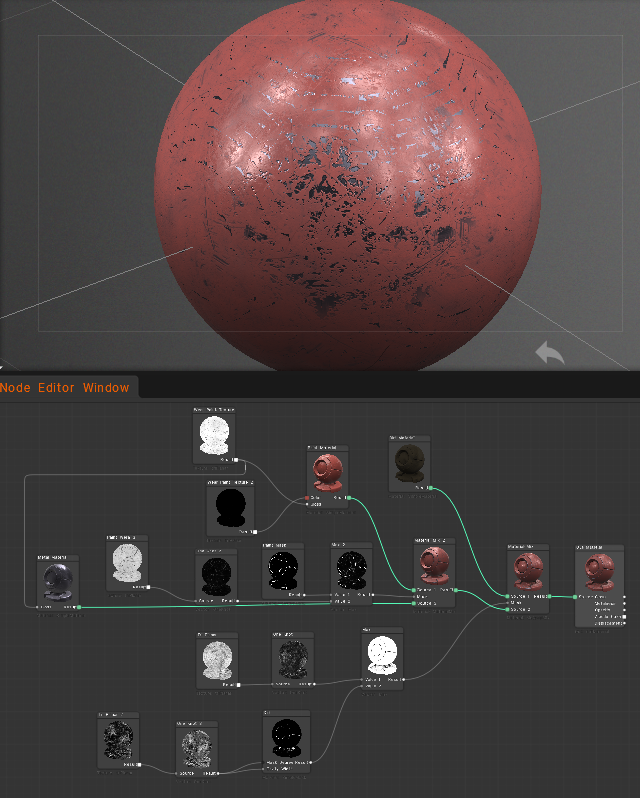
    On v2025 nodes will only work with sculpted objects. On v2026 work on Sculpted and Painted Objects.

    New features found on version 2026+:

    • the node system has been updated to prevent links between incompatible properties.
    • The material preview renderer has been updated.
    • A button for inverting input channels has been added.
    • Required maps, such as Ambient Occlusion and Curvature, are now automatically calculated.
    • The ability to use input channel correction curves in the node source code has been added.

    Here are the steps


    • Switch to the “Nodes” workspace.
    • Create a new node graph.
    • Add a “Voxel Displacement” node to your graph.
    • Connect the necessary input nodes, such as texture maps or procedural textures, to define the displacement pattern.
    • Adjust the parameters of the “Voxel Displacement” node to control the intensity and direction of the displacement.
    • Apply the node graph to your voxel object to see the displacement effect.

    This process allows you to create complex displacement patterns using a visual node-based approach.
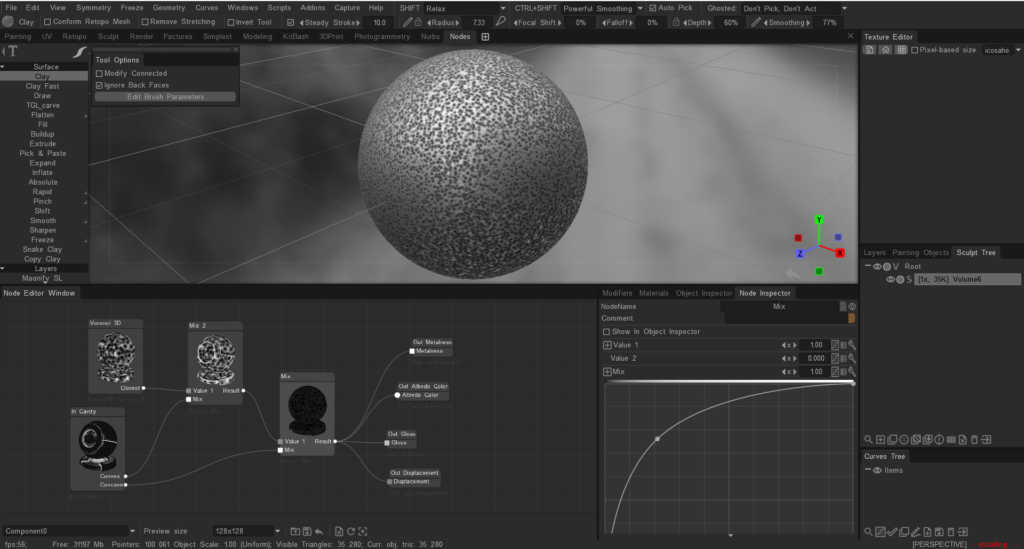
    Node system for painting


    The node system for painting is available an v2026 as it is primarily used for creating shaders and procedural textures for Materials.

    Painting in 3DCoat is typically done using the tools and features available in the Paint Room, such as brushes, layers, and smart materials.

    If you are looking to create complex textures or effects, you can use the existing painting tools and techniques, but the node system is not used for painting directly.

    Tutorials


    3DCoat 2026 GPU version Intro: A short video demonstrating the main functions.

    3DCoat Nodal Network Introduction (for Sculpt Objects): This video is a very brief introduction to the Nodal Network, first available for dense Voxel or High Poly objects within the Sculpt workspace, using shaders as the base.
    Once the user is satisfied with the results, they can later bake those shaders to a material.
    In the 2026 Release, this nodal network will be available for the Paint workspace (via PPP/Per Pixel Painting mode), offering an unprecedented combination of powerful Texture Painting tools and Nodal Material creation.

    Was this helpful?

    Yes  No
    Related Articles
    • GPU Texturing
    • Vector
    • Volumes
    • Modifiers
    • Materials
    • Masks
    Previously
    Mesh zum NURBS-Raum
    Up Next
    Sculpt-Shader Nodes Library
    AI:
    Hi! How can I help you?
    Attention: This is a beta version of AI chat. Some answers may be wrong. See full version of AI chat