• Українська
  • Документація 3DCoat
  • Chapters
    • Знайомство з 3DCoat
    • Починаємо
    • Інтерфейс і навігація
    • Компоненти Brush
    • Робочі місця Кімнати
    • Scripting та Core API
    • Питання/Відповіді
    • licensing
    • Навчальні посібники
  • Pilgway
  • Products
    • 3DCoat
    • 3DCoatTextura
    • 3DCoatPrint
    • PBRLibrary
  • Blog Posts
    • Creating 3D Character Using 3DCoat
  • Store
  • Українська Українська
    • English English
    • Español Español
    • Deutsch Deutsch
    • Français Français
    • 日本語 日本語
    • Русский Русский
    • 한국어 한국어
    • Polski Polski
    • 中文 (中国) 中文 (中国)
    • Português Português
    • Italiano Italiano
    • Suomi Suomi
    • Svenska Svenska
    • 中文 (台灣) 中文 (台灣)
    • Dansk Dansk
    • Slovenčina Slovenčina
    • Türkçe Türkçe
    • Nederlands Nederlands
    • Magyar Magyar
    • ไทย ไทย
    • हिन्दी हिन्दी
    • Ελληνικά Ελληνικά
    • Tiếng Việt Tiếng Việt
    • Lietuviškai Lietuviškai
    • Latviešu valoda Latviešu valoda
    • Eesti Eesti
    • Čeština Čeština
    • Română Română
    • Norsk Bokmål Norsk Bokmål
  • Документація 3DCoat
  • Chapters
    • Знайомство з 3DCoat
    • Починаємо
    • Інтерфейс і навігація
    • Компоненти Brush
    • Робочі місця Кімнати
    • Scripting та Core API
    • Питання/Відповіді
    • licensing
    • Навчальні посібники
  • Pilgway
  • Products
    • 3DCoat
    • 3DCoatTextura
    • 3DCoatPrint
    • PBRLibrary
  • Blog Posts
    • Creating 3D Character Using 3DCoat
  • Store
  • Українська Українська
    • English English
    • Español Español
    • Deutsch Deutsch
    • Français Français
    • 日本語 日本語
    • Русский Русский
    • 한국어 한국어
    • Polski Polski
    • 中文 (中国) 中文 (中国)
    • Português Português
    • Italiano Italiano
    • Suomi Suomi
    • Svenska Svenska
    • 中文 (台灣) 中文 (台灣)
    • Dansk Dansk
    • Slovenčina Slovenčina
    • Türkçe Türkçe
    • Nederlands Nederlands
    • Magyar Magyar
    • ไทย ไทย
    • हिन्दी हिन्दी
    • Ελληνικά Ελληνικά
    • Tiếng Việt Tiếng Việt
    • Lietuviškai Lietuviškai
    • Latviešu valoda Latviešu valoda
    • Eesti Eesti
    • Čeština Čeština
    • Română Română
    • Norsk Bokmål Norsk Bokmål
Expand All Collapse All
  • Знайомство з 3DCoat
  • Починаємо
    • System requirements
    • Why 3DCoat is Unique?
    • Активація 3DCoat
    • Помилка запуску
      • Startup error Mac
    • Color management
    • Upgrading permanent license
    • Linux Setup
      • Linux initial setup per-user installation
      • Linux initial setup for system
      • Tablet setup
      • To GTK3 from GTK2
      • Error libicuuc.so.70
    • Структура папок
      • Custom documents folder
    • Різні форми «резолюції»
    • Tablet on Window
    • Import та Export
    • Applinks в 3DCoat
      • Посилання на додаток Blender
        • Blender with the Applink in Linux
      • Blender 4.2/3/4/5 applink
      • Max Applink
      • Houdini applink
      • Lightwave uplink
  • Navigation
    • Відкриття діалогового вікна (меню швидкого запуску)
    • Панель навігації
    • Камера та навігація
      • Customize Navigation as Blender
    • Viewport Navigation Gizmo
    • Left tool panel
    •  Activity Bar
    • Навігація за допомогою пристроїв 3DConnexion
      • How to compile Spacenavd on non Ubuntu distro
    • Space Bar Menu
    • Stylus doesn’t work in sculpting
    • Гарячі клавіші
  • Інтерфейс і навігація
    • Меню «Файл».
    • Меню редагування
      • Calculate Curvature
      • Calculate Occlusion
      • Light Baking Tool
      • Уподобання
    • Перегляд меню
    • Симетрія
    • Textures
    • Calculate
    • Меню шарів
    • Заморозити меню
    • Hide
    • Bake
    • Криві 2022
      • Меню кривих
      • Curves Properties RMB
      • Заповніть сітчастим шаром
      • Scale of imported curves
    • Меню Windows
      • Спливаючі панелі Windows із вкладками
      • Повзунки
    • Scripts
    • Addons
    • Capture
    • Меню довідки
    • Налаштування
    • Змінити або створити нову кімнату
  • Компоненти Brush
    • Верхня панель Brush
    • Щітки загального користування
      • Створюйте пензлі та наклейки
      • Створення альфа-версії з поточного скульпту
      • Створіть Brush із тривимірного об’єкта
      • Create brushes based on Curves
      • Load photoshop .abr brushes
    • Штрихи
      • Криві спливаюче меню
    • Варіанти Brush
    • Обмежувач умов
    • Смуги панелі
    • Панель трафаретів
    • Розумні матеріали
      • Додайте нові зображення або матеріали
      • Приєднайте розумний матеріал до шару
      • Import Quixel Material
    • Як створити стилі для Brush
  • Робочі місця Кімнати
    • Painting
      • Painting текстур і режими
        • Per-Pixel Painting
        • Painting зміщення (мікровершина)
        • Painting Ptex
        • Painting поверхні (поліфарбування)
      • Імпорт до кімнати Painting
        • Initial CC subdivision
        • UV Set smoothing
        • Sharp (hard) edge
        • Блокування нормалей
        • Завантажити новий макет UV після зміни моделі
        • DAZ Genesis models into 3DCoat
        • ID map
      • Меню робочої області Painting
        • Edit menu
        • Меню текстур
          • Інструменти для Baking текстури
        • Сховати
        • Меню для Bake Paint
        • Вибір кольорів
      • Surface Materials
      • Верхня панель для Painting
      • Панель шарів
        • Панель змішування
        • Layer and Clipping Masks
      • Інструменти для Painting кімнати
      • Opacity – Прозорість
      • Налаштуйте робочу область
        • Набір інструментів налаштування
        • Експорт із кімнати налаштування
      • Панель попереднього перегляду маски/матеріалу
      • Експорт із кімнати Painting
    • Робоча область UV
      • Верхня UV панель
      • Ліва панель інструментів UV
      • Панель попереднього перегляду UV
      • Приклад робочого процесу UV
      • Імпорт в UV кімнату
      • Експорт з UV кімнати
    • Ретопологія
      • Імпорт до кімнати Retopo
      • Меню Retopo Mesh і меню випікання
        • Режим віртуального дзеркала
      • Bake menu
        • Treat Poly Groups as Paint Objects
        • Baking guide
      • Інструмент «Обведення» в ретопології
      • Верхня панель
        • Виберіть геометрію
      • Ліва панель інструментів у кімнаті ретопології
        • Загальне призначення та функції
        • Додайте геометрію
        • Інструменти налаштування Retopo
        • UV інструменти
        • Команди для кабінету ретопології
      • АВТОРЕТОПО
        • Autopo guide
      • Групи Poly
    • Ліпити
      • Sculpt Layer
      • Ліпити дерево
      • Параметри Brush для скульптури
      • Top Bar
      • Brush двигун
      • Підменю Геометрія
      • Скульптуйте меню «Клацання правою кнопкою миші».
      • Шейдери
      • Voxel режим
        • Чиста Voxel скульптура
        • Щільність і роздільна здатність
        • Clay Engine
        • Voxel інструменти
        • Інструменти поверхні на вокселях
        • Інструменти налаштування Voxel
        • Об'ємний Painting
        • Інструменти Voxel Objects
      • Поверхневий режим
        • Поверхневі інструменти
        • Поверхневі спеціальні інструменти
        • Surface Layer
        • Інструменти для регулювання поверхні
        • Painting поверхні
        • Інструменти Surface Objects
        • Багаторівнева роздільна здатність
          • Multires tools
          • Multires adjust
          • Multires commands
      • Ліпити криві
        • Сплайн-криві
        • Splines model creation
      • Векторне зміщення
      • Інструменти трансформації поверхні
        • Інструменти Voxel перетворення
        • Instancer
        • Move
        • Pose
        • Fit
        • Reproject
        • Surface Array
      • Voxel примітиви та інструменти Import
      • Живі логічні значення
      • Команди для Sculpt room
      • Import до Sculpt Room
      • Експорт із кімнати скульптур
    • Рендер
      • Comparison of different roughness values
      • Функції панелі візуалізації
      • Поворотний стіл
      • Fakebake освітлення - не PBR-
    • Factures
      • робочий процес
    • Найпростіший
    • Моделювання
      • Mesh Menu
      • Ліва панель інструментів у кімнаті моделювання
        • Додайте геометрію
          • Вибране
        • Твік
        • Smart Hybrid
        • UV
          • Команди
        • Ціла сітка
      • Приклад поверхні лофт від Fluffy
      • Блокування від Poeboi
      • Import Zbrush Polygroups for UV mapping
    • Kitbash - швидке створення 3D моделей
      • Create kitbash
      • Left tool panel Kitbash
    • 3DPrint
    • Photogrammetry
      • How to install Reality Capture
      • Reality Capture doesn’t show up ?
    • Сітка до кімнати NURBS
    • Nodes
      • Бібліотека вузлів шейдерів скульптури
  • Scripting та Core API
    • Scripting
    • Core API
    • API Python
  • Безкоштовний 3DCoatPrint

Mesh Menu

638 views 0

Written by Carlos
December 7, 2024

You can find the Mesh and Bake menu in the top toolbar of the Modeling workspace. Below are listed all of the functions in this menu:

Mesh Menu
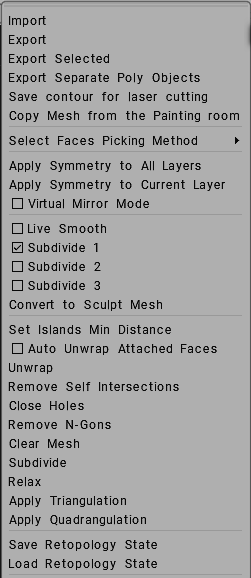

Import: Import an external mesh to continue creating topology started in another 3D modeling program.
Export: Exports a mesh to continue work in an external 3D application.
Export selected: Exports only the selected faces of yourmesh.
Export Separated Poly (Retopo) Objects: Exports each PolyGroup as a separate file. The name of each generated file will contain the group name.
Save Contour for laser cutting: Exports the connected boundary of a UV island to facilitate laser or CNC cutting.
Copy Mesh From Paint Room: Move mesh from the Paint room into the Modeling room. In this case, the objects will be colored; color will be used in baking and merging into the scene.


Select Faces Picking Method: Selects faces based on the following options, Triangles, Quadrangles, N-Gons, and Stars, and Improve Quad Topology.


Apply symmetry to all layers: Makes all symmetrical operations permanent for all PolyGroups allowing them to be “Baked” into the Paint Room and “Unwrapped” in the UV Room.
Apply symmetry to the current layer: Makes only the selected PolyGroup permanently symmetrically for Merging and Unwrapping.
Virtual mirror mode: This option is applicable only if symmetry is enabled. In this mode, you should create topology only on one side of the symmetry. The opposite side will be shown as in the mirror without the actual creation of polygons. You need only work on one side of the mesh.

Virtual mirror should work for you, whether you have deleted half of your model or not. Even though things might not look perfectly symmetrical in the editing process, using "Apply symmetry..." from the "Retopo" menu should rectify that and produce perfectly mirrored geometry.

After you finish, you may “Apply symmetry” to make the symmetrical topology permanent. If this mode is turned off, polygons will be automatically created on both sides of the symmetry.

To make it always work, you have to select the layer and click the “select all faces of this layer” button. That way, the “apply symmetry” always works perfectly.

Working w/ Symmetry (Retopo/UVs): This video continues the Introduction to working with Symmetry, focusing on the Modeling Room and UVs).


Live Smooth provides the user with a subdivided, higher polygon version in these Rooms, that adapts on the fly to all changes made to the low poly mesh. Click on live smooth and notice in the sculpt tree panel you immediately get a new subdivided version of the model.

Live Smooth is just for preview purposes, of how polygon model would look like if subdivided. It functions as a preview of the Modeling/Retopo mesh, enabling smooth editing, which can be permanently applied by unlinking it from the low-poly mesh.

Live Smooth toolset wasn’t designed to have Sculpt mesh changes drive changes to the Modeling/Retopo meshes, but the other way around, instead.
You have a feature in the Sculpt Room to make Retopo Meshes conform to changes in the Sculpt Workspace. That is called Conform Retopo Mesh, and you can check/uncheck it in the Toolbar (just above the viewport) in the Sculpt Workspace. It is sort of the reverse of Live Smooth.
When you are working with Live Smooth, the concept is to make changes to the Modeling/Retopo meshes and you can see the changes applied in the subdivided (yes triangles) Live Smooth/Sculpt Mesh. Treat the Sculpt mesh, in this scenario, as just a preview of the Subdivided Modeling mesh and nothing more.
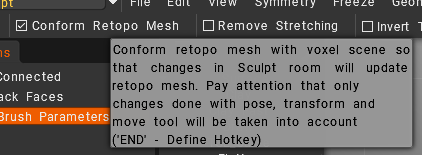
If you are done making changes to/manipulating the low poly Modeling mesh, and want to switch to making changes to the Sculpt Mesh, go to the MESH menu in the Modeling Room > click Unlink Sculpt Mesh. That breaks the link between the low poly mesh and the high poly mesh, but leaves both intact in their respective workspaces. Next, check Conform Retopo Mesh in the toolbar, and proceed to make your sculpting edits. 


Subdivide with CC levels 1, 2, 3: Choose the subdivision level and see the changes in the viewport.
Convert to Sculpt Mesh: Copy the 3D Polygonal Object in Polygroup and send it to the Sculpt Tree.


Set Islands Min Distance: Set Islands Min Distance.
Auto unwrap attached faces: Check this option to create UVs automatically. Auto-unwrap faces that were created nearby to the already unwrapped islands. Unwrapping will be performed each time when you switch new tool.
Unwrap: Fit all islands onto the UV map. It is the same command found in the “UV Tools” section of the Tool Panel.
Close holes: A valuable option that attempts to repair holes in imported meshes, especially dense scanned meshes.
Remove N-Gons: Remove N-Gons
Clear mesh: Clears the whole mesh from the selected PolyGroup.
Subdivide: Subdivides the whole mesh, using one iteration, from the current PolyGroup.
Catmull-Clark subdivision in retopo room. Two commands are “Subdivide selected” and “Subdivide the whole group”.
Relax: Relaxes the mesh to aid in snapping to the reference surface, for the currently selected PolyGroup.
Apply Triangulation: Triangulation of all visible mesh as an entire.
Apply Quadrangulation: Quadrangulation all visible mesh as an entire.


Save Retopology State: Store the retopology state in a separate file.
Load Retopology State: Restore the retopology state from a separate file.

Tutorials


Live Smooth: This video is a quick demonstration of the Live Smooth feature in 3DCoat’s Retopo & Modeling workspaces. It provides the user with a subdivided, higher polygon version in these workspaces, that adapts on the fly to all changes made to the low poly mesh.

Low-Poly Modeling with Live Smooth: this video demonstrates fully supported Low-Poly Modeling (a dedicated room and functionality) with Live Smooth in 3DCoat 2021. The toolset shown is part of the 3DCoat 2021 release expected in Q4 2020. To access it, simply go to the MESH menu (in the Retopo or Modeling Workspaces) and check SCULPT MESH. 1 level of Subdivision is the default, but you can change it, in the menu items below SCULPT MESH.

Tags:mesh menu

Was this helpful?

Yes  No
Related Articles
  • Surface Layer
  • Error libicuuc.so.70
  • Space Bar Menu
  • Surface Materials
  • Factures
  • ID map
Previously
Моделювання
Up Next
Ліва панель інструментів у кімнаті моделювання
AI:
Hi! How can I help you?
Attention: This is a beta version of AI chat. Some answers may be wrong. See full version of AI chat